
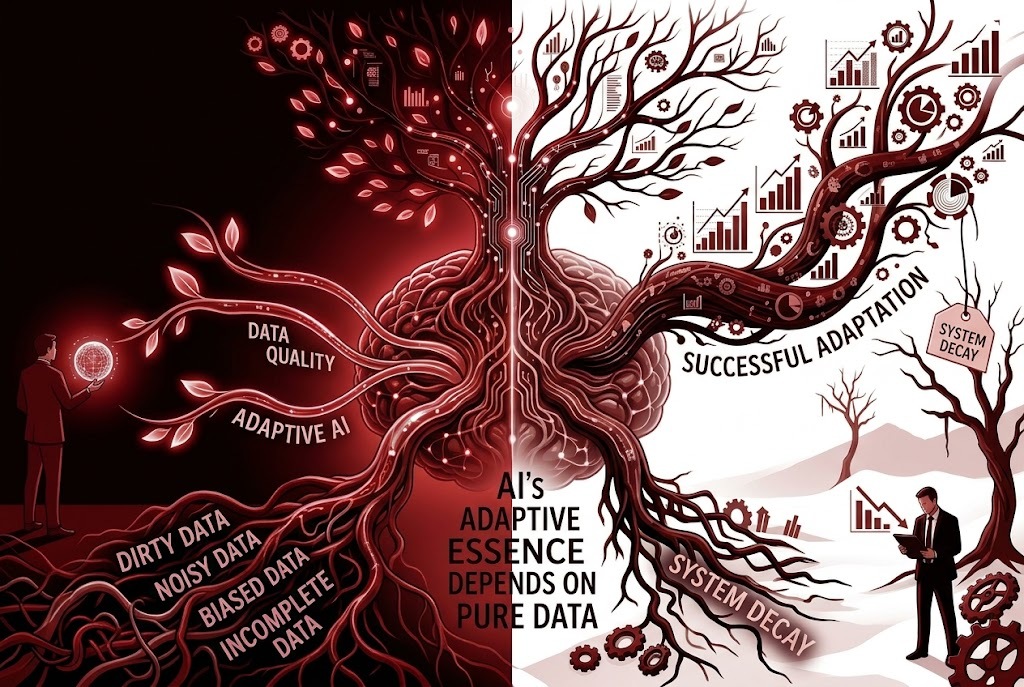
Everyone is investing in AI. Budgets are being allocated, pilots are being launched, vendors are being selected. The ambition is real and the technology is genuinely capable. But a large proportion of those investments will underperform. Not because the AI is wrong, but because the data it depends on is fragmented, inconsistent, and ungoverned.
AI does not generate intelligence from nothing. It retrieves, processes, and generates from whatever data it is given. Give it fragmented customer records and it produces fragmented insights. Give it inconsistent event data and it learns inconsistent patterns. Give it siloed systems that have never been reconciled and it automates the silos rather than resolving them. The quality ceiling of any AI system is set not by the model, but by the data underneath it.
The most useful reframe treats data less like a resource to extract and more like oxygen, something that has to keep flowing continuously to every decision point in the organisation. Oil gets mined, refined, and burned. Oxygen circulates. Organisations that mine data into centralised silos and surface it in quarterly reports will find their AI has nothing useful to act on. Agentic AI, systems that reason and act autonomously, does not need more data. It needs data that flows.
The deeper shift is from a volume-and-accuracy model of data quality to one based on context, connections, and adaptability. Traditional data strategy asked: do we have enough data, and is it correct? AI strategy asks something harder: does the data carry the relationships and meaning that allow a model to reason? A Formula 1 team does not win by having the most telemetry. It wins by capturing the right signals and turning them into actionable decisions faster than the competition. Most organisations are still optimising for the volume of laps, not the speed of the pit stop.
This post is about that ceiling: why it exists, what creates it, and what organisations need to build before AI investments can deliver what the vendor presentations promise.
What AI Actually Needs From Your Data
To understand why data quality determines AI performance, it helps to understand what AI is actually doing when it generates an output. Whether it is a recommendation engine, a customer support assistant, a personalisation model, or a predictive churn tool, every AI system is doing some version of the same thing: finding patterns in historical data, retrieving relevant context, and using both to generate an output.
This means three data properties determine whether the output is trustworthy:
- Completeness: If key events or interactions are missing from the data, the AI has a structurally incomplete picture of the customer or process it is modelling.
- Consistency: If the same customer appears under different identifiers across systems, the AI is effectively modelling several different fictional customers instead of one real one.
- Timeliness: If the data feeding the AI is days or weeks old, real-time personalisation or dynamic pricing becomes impossible regardless of the sophistication of the model.
Most organisations investing in AI have a data estate with gaps across all three properties. The AI investment does not fix those gaps; it only exposes them at scale, and at the cost of the AI budget rather than the data budget.
The practical consequence: An LLM given access to your knowledge base is only as useful as the knowledge base. A recommendation engine trained on incomplete purchase history recommends poorly. A churn model built on inconsistent customer IDs misidentifies who is at risk. None of this is really about the model. It is about the data feeding it.
The Gap Between Platform And Operating Model
The most persistent failure underneath poor AI performance is treating data as a technology project rather than an operating model change. Organisations invest in platforms (a CDP, a data lake, an AI personalisation engine) and assume the investment in infrastructure is equivalent to investment in data capability. Unfortunately, it is not.
If a CDP is the platform in question, “CDPs Explained, and Why Most Implementations Fail” covers exactly why buying one rarely closes this gap on its own.
The pattern is consistent: a company buys an enterprise data platform, engineering teams centralise pipelines, dashboards improve, and reports reach leadership. Then AI is deployed on top of this infrastructure. And the AI underperforms, because the underlying data still has fragmented customer identity, inconsistent definitions, and untrusted metrics, the problems the platform investment did not resolve.

The strategy becomes 'we implemented a platform' instead of 'we changed how the organisation makes decisions.' AI built on the first produces AI-shaped reporting. AI built on the second produces business transformation.
The six data failure modes that most directly undermine AI performance:
- No unified customer identity: the AI is modelling multiple fictional versions of the same customer
- Conflicting metrics across departments: the AI is trained on contested definitions of the same business concept
- AI launched before data foundations mature: models built on fragmented data learn fragmented patterns
- Reporting prioritised over activation: data informs presentations but does not reach the systems the AI needs to act on
- Data teams measured on delivery not outcomes: pipelines ship but the business value they enable goes unmeasured
- No use case prioritisation: AI is applied broadly rather than focused on the decisions where data quality is highest and business value clearest
The Identity Problem: Why AI Personalisation So Often Fails
The most direct path from data fragmentation to AI failure runs through customer identity. Personalisation, recommendation, churn prediction, and lifetime value modelling all depend on a coherent, unified view of the customer. Without it, these AI capabilities are not actually personalized, but just a pattern-match based on what the system thinks this customer is, which is usually a partial and inconsistent composite of several data records.
A common pattern across retail and service organisations: the same customer exists as cust_29471 in the CRM, mbr_4829A in the loyalty app, usr_88120 in the e-commerce platform, an anonymous device ID in paid media, and a phone number in WhatsApp. No system knows these are the same person. The AI, whether a recommendation engine, a churn model, or a RAG-powered assistant, works with whichever fragment it has access to.

The business consequences of identity fragmentation are not abstract. High-value customers receive irrelevant recommendations because their purchase history is split across systems the AI cannot reconcile. Churn-risk customers are invisible because the signals are distributed across channels that were never unified. Attribution models confidently report on outcomes they cannot actually measure. Marketing spend rises while retention stagnates and the AI investment is blamed for underperforming when the data foundation it was built on was the actual problem.
The forcing events that reveal how serious the identity problem is tend to be AI-related: an attempt to deploy personalisation at scale, a RAG system that retrieves the wrong customer context, or a predictive model that produces results executives do not recognise as credible. By the time AI makes the identity problem visible, significant investment has already been made on top of an unresolved foundation.
The principle: Fix identity before deploying AI. A unified customer record is the prerequisite for any AI system that operates on customer data, not a nice-to-have bolted on afterward. Everything built before that is built on sand.
Data quality problems have always had business costs. But AI amplifies those costs as it operates at speed and scale, which means data problems that were slow and localised become fast and systemic. Understanding the failure modes and their specific AI consequences is the starting point for knowing where to invest first.

Each failure mode has a specific AI consequence. Fragmented identity means AI personalisation is working from an incomplete picture. Conflicting metrics means AI models are trained on contested definitions of business success. Reporting-over-activation means AI insight never reaches the systems that could act on it. No use case prioritisation means AI is deployed where data quality is lowest and value is least clear, rather than where the return would be highest.
The compounding effect is what makes data debt so costly in an AI context. Poor data does not just limit AI performance today; it means the AI system learns incorrect patterns that become harder to correct as the model is used and retrained. Technical debt in data compounds in a way that code debt does not.
The Infrastructure AI Actually Reads
Fixing data quality is necessary but not sufficient. AI does not read databases, it reads meaning. The gap between a technically correct dataset and an AI-ready one is the semantic layer: the translation infrastructure that converts raw data into context a model can reason with.
This layer includes ontologies, the common business language that prevents the AI from treating “revenue,” “net revenue,” and “total revenue” as three unrelated concepts, and knowledge graphs that map the relationships between entities the model needs to navigate. Without this layer, even clean data produces an AI that is factually correct but contextually confused: it can retrieve the right number but cannot explain what it means or how it connects to the decision being made.
Metadata plays a parallel role. Organisations that treat metadata as administrative documentation (a column description written once and forgotten) are missing its function in an AI system. Metadata is decision infrastructure: it tells the model how confident to be about a data point, how recent it is, who owns it, and what it was originally designed to measure. An AI agent that cannot evaluate the reliability of its own inputs cannot reason reliably about anything downstream. Ownership and lineage matter for the same reason: they are the conditions under which AI outputs can be trusted, not paperwork attached after the fact.
The practical architecture that supports this is a layered data model: raw inputs at the base (preserved and auditable), cleaned and unified domain records in a middle layer, and refined business-ready datasets at the top. Each layer carries defined ownership, quality standards, and metadata. Each is reusable across use cases rather than rebuilt for each new request. The AI operates at the top layer, with the confidence that the layers beneath it have done their work. Organisations that skip this architecture and point AI directly at raw data are not deploying AI on their data. They are deploying AI on their data problems.
For a closer look at the four layers themselves, warehouse, CDP, BI tool, and identity resolution, see “Making Sense of Your Data Stack.”
The GCC Dimension: Where AI Ambition Meets Data Reality
The GCC presents a specific version of this challenge. Executive appetite for AI is strong and often stronger than in more mature markets. The investment is real. But the data foundations that AI requires are at varying stages of readiness, and five patterns make the gap particularly acute in the region.

Architecture Leapfrogging
GCC organisations frequently attempt advanced AI and personalisation before mastering the governance, identity resolution, and process standardisation that those capabilities require. The ambition is genuine and is a competitive asset when the foundation supports it. The gap is that AI pilots stall. The technology usually works fine. The data those models need does not exist yet in a usable, consistent form.
The corrective is a startup mindset applied to data: minimum viable automations rather than enterprise-wide AI transformations. Identify the use case where data quality is already strongest, build a narrow proof of value, and scale from there. Organisations that attempt comprehensive AI deployment before validating data readiness burn budget on the wrong sequencing. Those that prove the model on a well-governed slice of data and use those early wins to fund the next layer of data investment, find that speed creates capacity. The initial discipline funds the scale.
Vendor-Led Strategy
When data strategy defaults to whatever the implementation partner recommends, the AI use cases that get prioritised are the ones the vendor's platform is best at demonstrating and not necessarily the ones where the organisation's data is strongest and the business value is clearest. Internal data product ownership is the corrective: defining the AI use cases and data requirements before the vendor conversation begins.
Identity Complexity
The GCC's multinational populations, WhatsApp-heavy engagement patterns, and offline-online fragmentation make identity resolution harder than standard CDP assumptions allow for. AI systems built on Western identity resolution logic will produce lower-quality outputs in the GCC context. The AI is not weaker here. The identity layer it is working with is more complex and less resolved.
Infrastructure Ahead Of Stewardship
Sophisticated infrastructure built on top of unclear data definitions and inconsistent KPIs means AI models are trained on data that the organisation itself cannot agree on. The symptom is familiar: executives do not trust the AI's recommendations. The model is not the problem. The data it was trained on reflects a contested view of the business.
AI Enthusiasm Outpacing Measurement
Deploying AI without the CLV frameworks, incrementality testing, and attribution models needed to evaluate its performance makes it impossible to know whether the investment is working. AI enthusiasm without measurement discipline produces the worst outcome: significant investment with no ability to determine whether it was justified.
AI Readiness: Where Does Your Organisation Sit?
AI readiness is a function of data maturity. The four stages below describe where most organisations actually sit and what the specific requirements are to move from one stage to the next.

Most GCC organisations sit between Stage 2 and Stage 3. The infrastructure investment has been made. What remains is the translation layer: the governance, identity resolution, and activation capability that converts infrastructure into the kind of data AI can reliably learn from and act on. Attempting to move from Stage 2 directly to Stage 4 AI deployment, skipping Stage 3, is the most common and expensive sequencing mistake in AI investment.
This four-stage view is the AI-specific lens. For the fuller organisational maturity model behind it, governance, ownership, and the path between stages, see “What Does Data Maturity Actually Mean for Your Business?”
What To Fix Before Scaling AI
The practical starting point is not a new AI platform. It is a data readiness assessment, an honest audit of the data quality, identity completeness, and governance maturity that the intended AI use cases actually require. The six components that most directly enable AI performance:
| Data requirement | Why it matters for AI |
|---|---|
| Unified customer identity | AI personalisation, churn prediction, and CLV modelling all depend on a coherent customer record. Fragmented identity means the AI is modelling fragments, not customers. |
| Consistent event tracking | AI models learn from behavioural data. Incomplete or inconsistently captured events produce models that have structural blind spots, things that happen but the AI never sees. |
| Agreed metric definitions | AI trained on contested KPI definitions learns ambiguity. Shared definitions across departments are a prerequisite for AI that produces outputs everyone can trust. |
| Business-led use case prioritisation | AI delivers the most value where data quality is highest and the business question is clearest. Starting with the use case, not the platform, ensures AI is applied where it can actually work. |
| Activation capability | AI insight that cannot reach the systems that act on it, like CRM, marketing automation, service platforms etc. does not change behaviour. Activation infrastructure matters as much as the model. |
| Measurement discipline | Without CLV frameworks, incrementality testing, and attribution, AI performance cannot be evaluated. Organisations that cannot measure AI ROI cannot improve it. |
The question is not whether to invest in AI. It is whether your data is ready for the AI you are investing in. The answer to that question determines whether the investment transforms the business or decorates the existing problems with a more expensive interface.
The organisations getting this right, across sectors as different as industrial manufacturing, financial services, and pharmaceuticals, share a common pattern. They treated data readiness as the primary investment, not the afterthought. They built their semantic and governance layers before their AI layers. And the efficiency they created through early, well-grounded AI wins funded the next cycle of investment. Speed creates capacity but only when the foundation it runs on is sound.