
Every data conversation eventually arrives at the stack: the collection of tools and platforms that capture, store, process, and activate data across an organisation. Vendors are eager to discuss it. Consultants build practices around it. Conferences dedicate entire tracks to it.
What gets discussed far less is sequencing: which layer to build first, how to match stack complexity to organisational maturity, and how to avoid the trap of assembling a sophisticated architecture on top of foundations that are not yet ready to support it. That is where most organisations go wrong. Not in the tools they choose, but in the order they choose them.
The Modern Data Stack: Six Layers Worth Understanding
A data stack is a set of interconnected layers, each serving a distinct purpose, not a single product. Understanding what each layer does, what it depends on, and where it typically fails is the starting point for making rational decisions about what your organisation actually needs.
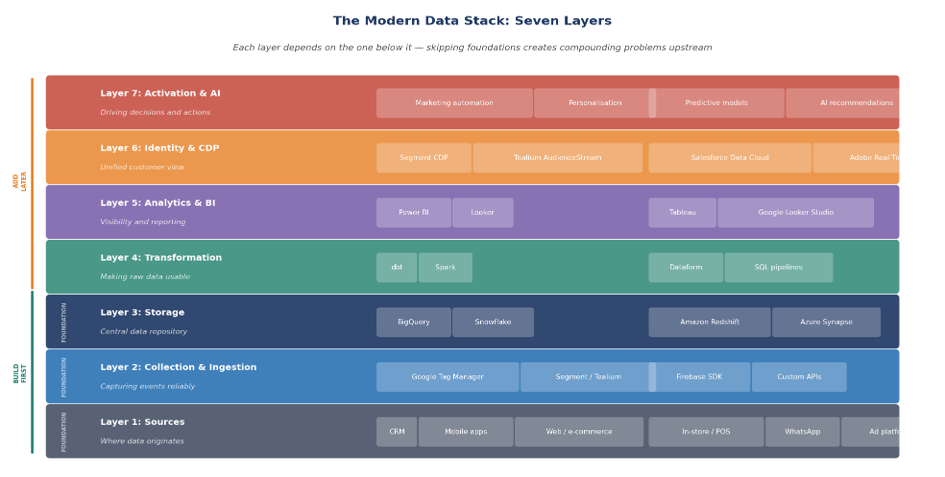
The architecture reads from the bottom up. Layer 1, Sources, is where data originates: every customer touchpoint, transaction, and interaction across CRM, POS, mobile app, web, WhatsApp, and advertising platforms. The fragmented identity problem described in “Why AI is Only as Good as Your Data” lives here. The same customer generates a different identifier in each source system, and everything built above this layer is only as reliable as the identity resolution at this foundation.
Layers 2 and 3, Ingestion and Storage, move data into a central repository and hold it at scale. Fivetran, Airbyte, and similar tools handle ingestion connectors; BigQuery, Snowflake, and Databricks handle storage. The common failure here is centralising data before fixing the quality and consistency problems upstream. A clean pipeline built on dirty source data is still dirty data, now at scale.
Layer 4, Transformation, is where raw data is cleaned, modelled, and joined into forms that analysts and systems can actually use. Tools like dbt have made this layer far more accessible. The failure mode is inconsistent modelling: different teams define the same metric differently, and the warehouse accumulates competing versions of the truth.
Layers 5 and 6, Analytics & AI, and Activation, sit at the top of the stack. Layer 5 generates insight, forecasts, and recommendations. Layer 6 pushes those outputs to where decisions are actually made: marketing platforms, sales tools, service systems, and frontline applications. These are also the layers where most organisations start building, before the lower four are stable.
The foundational rule: Each layer depends on the quality of the layer below it. No amount of sophisticated analytics corrects for fragmented identity at Layer 1. No AI model reliably outperforms the data it was trained on. Build from the bottom up, not from the ambition down.
The Sequencing Trap: Why Order Matters More Than Tools
The most common data stack failure is not choosing the wrong platform. It is choosing the right platform at the wrong time. Organisations routinely invest in enterprise-grade AI, CDPs, and real-time infrastructure before they have solved the basics: customer identity, data governance, event tracking, and operational adoption. The result is predictable and expensive.
The wrong order typically looks like this: an organisation purchases an enterprise CDP or real-time personalisation engine early in its modernisation journey, driven by vendor enthusiasm and executive ambition. Implementation begins. Then the project team discovers that customer IDs are fragmented across source systems, that the event tracking required to feed the CDP was never properly implemented, and that the marketing teams who were meant to use the activation layer do not have the operational processes to act on what it produces. The platform launches. Adoption is low. It functions as a reporting layer. ROI is unclear.
'Modern stack implementation' and 'data transformation' are not the same thing. One is a technology decision. The other is an operating model change. Most organisations mistake one for the other.
The right order starts with the foundations: identity resolution and basic event tracking, then CRM plus analytics plus a central warehouse, then governance and activation discipline, and only then the advanced layers (CDP, AI personalisation, real-time infrastructure) when the maturity to use them actually exists.
What This Looks Like In Practice
Two anonymised examples from direct experience in the regional illustrate how sequencing failures manifest, and how they compound.
The QSR Enterprise CDP
A quick-service restaurant group invested in an enterprise CDP as part of a broader digital transformation initiative. The ambition was a unified customer view across their app, loyalty programme, in-store transactions, and delivery platforms: the foundation for personalised offers and retention marketing.
The implementation stalled. SDK limitations meant the CDP was not receiving all the required data from the mobile app, and what it did receive arrived with significant delays. More critically, the customer touchpoints had not been redesigned to feed data into the activation layer in an optimised way. The CDP could theoretically unify the customer, but the integration points that would have made that unification reliable had never been properly built.
The result: an enterprise CDP running at a fraction of its designed capacity, functioning primarily as a more expensive version of the segmentation tool the business already had. The platform was not the problem. The sequencing was. The identity and tracking foundations should have been solved first.
The MMP And Warehouse Identifier Mismatch
A second organisation deployed a Mobile Measurement Platform (MMP) to track app install attribution and in-app event data, alongside a cloud data warehouse for centralised analytics. The intent was to combine campaign attribution from the MMP with behavioural and transactional data in the warehouse: a standard, sensible architecture.
The integration failed. The MMP and the warehouse used different user identifiers. The MMP tracked users by its own device-level ID. The warehouse tracked users by the internal customer ID from the CRM. There was no reliable join key between them. Attribution data and behavioural data could not be combined at the user level, making the cross-channel analytics the entire project was designed to enable structurally impossible.
The fix required rebuilding the identifier strategy from the source systems up, precisely the foundational work that should have preceded the tool selection. Two platforms, both individually functional, rendered unable to work together by an identity decision that was never properly made.
The pattern: Both failures share the same root cause: tool selection and implementation preceded the resolution of foundational identity and tracking decisions. The platforms were capable. The foundations they required had not been built.
What To Build First: The Sensible Starter Stack
For most mid-sized regional organisations, the right first stack is significantly simpler than what vendors typically propose. The goal at this stage is not full-scale enterprise architecture. It is reliable visibility, usable reporting, and operational adoption, the conditions under which more advanced capabilities become viable.
The starter stack has six components. A CRM (Salesforce or HubSpot) provides the operational backbone for customer data and the first layer of identity. Web and app analytics via GA4 or Mixpanel establishes behavioural tracking and funnel visibility. Power BI provides centralised reporting that gives leadership a single version of the truth. Marketing automation via HubSpot or Klaviyo connects the data to outreach. Basic customer unification (a CDP-lite approach rather than a full enterprise deployment) begins the identity resolution work. And for the regional specifically, WhatsApp integration via 360dialog or Wati is not optional: it is core customer infrastructure in this market and should be treated as such from the start.
The “basic customer unification” step above is a CDP-lite approach on purpose. What a full CDP actually does, and why most implementations of it fail, is covered in “CDPs Explained, and Why Most Implementations Fail.”
More advanced layers (Tealium, Segment, Salesforce Data Cloud, Adobe Real-Time CDP) make sense later, once governance exists, once identity resolution is working, once frontline teams are actually using data in their daily decisions. Deploying them earlier does not accelerate that maturity. It creates complexity that obscures the foundational gaps.
The governing principle: Choose your stack based on what your organisation can actually operate and adopt, not on what represents best-in-class at theoretical scale. A well-used simpler stack outperforms a poorly-adopted sophisticated one every time.
Four Region-Specific Stack Considerations
Global data stack recommendations are written for Western markets. The regional has specific characteristics that meaningfully affect architecture decisions, and that most platform vendors either underestimate or address as an afterthought.
WhatsApp As Core Infrastructure
In most regional markets, WhatsApp is the primary engagement channel, not a supplementary one. Customer service, campaign delivery, transactional notifications, and loyalty communications all flow through it at volumes and frequencies that dwarf email and push notifications in many sectors.
Most global martech stacks were not designed with WhatsApp as a first-class data source. They treat it as an integration add-on, often with limited event capture, inconsistent attribution, and fragmented identity handling. For regional organisations, this is a structural gap that needs to be explicitly addressed in stack design, not patched in later.
Arabic Language Gaps
Arabic support across global data and analytics platforms is improving but remains uneven. NLP quality for Arabic text analysis, right-to-left UX rendering, multilingual identity handling (matching customer records across Arabic and Latin script representations of the same name), and Arabic-language labelling in analytics dashboards all vary significantly across major platforms.
The practical advice: test your core flows in Arabic before committing to any platform, not after implementation begins. Gaps discovered post-deployment are expensive to fix and often require workarounds that compound technical debt.
Vendor Reliance And Stack Complexity
The regional data ecosystem has a higher density of SI partner-led implementations than most Western markets. This is not inherently problematic; capable implementation partners add genuine value. The risk is that stack recommendations reflect partner capability and commercial relationships rather than organisational need. The recommended architecture becomes what the partner knows how to build, not what the organisation can operate.
The mitigation is straightforward in principle: define your internal data capability ceiling before architecture decisions are made. A stack that exceeds internal capacity to operate will underdeliver regardless of its technical sophistication.
Data Residency In Regulated Sectors
Government, banking, telecom, and healthcare organisations across the regional face data localisation requirements that affect architecture decisions at the storage and processing layers. The UAE PDPL, Saudi Arabia's PDPL, and the DIFC and ADGM data protection frameworks each have provisions relevant to where data can be stored and how it can be processed. These requirements should inform cloud provider selection, warehouse configuration, and vendor evaluation from the start. Retrofitting compliance into an existing architecture is significantly more expensive than building it in.
How To Evaluate Stack Decisions
Four questions that cut through vendor noise and apply regardless of organisation size or sector:
| Question | What a good answer looks like |
|---|---|
| Are our identity foundations ready? | You can describe how customer records are matched across your key systems. If you cannot, the CDP or AI platform should wait. |
| Can our teams actually operate this? | The tool complexity does not exceed internal capability. The adoption plan exists before the implementation begins. |
| Does it solve a named business problem? | There is a specific decision that will be made differently because of this tool. 'Better data' is not a business problem. |
| Have we validated region-specific requirements? | WhatsApp integration, Arabic support, data residency, and regional compliance have been explicitly evaluated, not assumed to be covered. |