
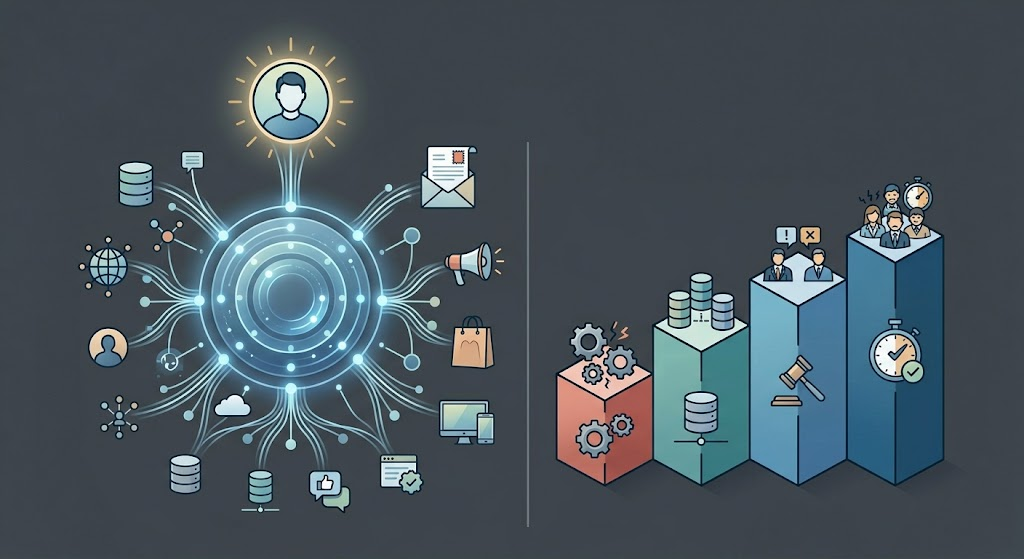
If you work in marketing or digital, you have almost certainly heard about Customer Data Platforms. You may have sat in a sales presentation where a vendor showed you a slide of every data source connecting into a single platform, producing a golden customer profile, feeding perfectly targeted campaigns across every channel, all running seamlessly while your marketing team makes smarter decisions faster.
Some of that is real. The vision of unified customer data, coherent audience intelligence, and consistent activation across touchpoints is genuinely achievable. But the gap between the vendor slide and the working implementation is where most organisations get lost, and it is a wider gap than most people anticipate before they start.
I have been involved in CDP implementations ranging from single-market deployments to ten-country rollouts for large consumer brands. The results, when done well, are significant. The failure modes, when done poorly, are expensive and demoralising. This post explains what a CDP actually is, what it is not, why most implementations underdeliver, and what the ones that work have in common.
A CDP is not a technology purchase. It is an organisational capability. The platform is the easiest part.
What A CDP Actually Is And What It Is Not
The confusion about CDPs starts with the name. 'Platform' suggests a tool. 'Data' suggests a database. 'Customer' suggests a CRM. None of these framings is quite right, and each one leads organisations toward the wrong expectations and the wrong questions when they are evaluating whether they need one.
| A CDP is NOT… | A CDP IS… | |
| ✗ A CRM: it does not manage relationships | ✓ A unification layer that resolves identity across sources | |
| ✗ A data warehouse: it does not store everything | ✓ An activation engine that makes data usable in campaigns | |
| ✗ An analytics tool: it does not produce reports | ✓ A profile builder that creates a single view of each customer | |
| ✗ A media buying platform: it does not run ads | ✓ An audience intelligence layer that feeds every channel | |
| ✗ A replacement for your existing stack | ✓ A connective tissue that makes your existing stack smarter |
The most useful way to think about a CDP is as connective tissue. It sits between your data sources (your website, your CRM, your advertising platforms, your app, your e-commerce system) and your activation channels. Its job is to ingest data from all of those sources, resolve identity across them (understanding that the email address, the cookie, and the mobile ID all belong to the same person), build unified customer profiles, and make those profiles available to every channel that needs to act on them.
That is a significant capability. It is also a significant undertaking. Which is why the failure rate is higher than the vendor community would like to admit.

▲ How a CDP works
Why Most CDP Implementations Fail
In my experience across multiple implementations, the platform itself is rarely the problem. CDPs from reputable vendors are technically capable. The failures almost always come from somewhere else and they tend to cluster around the same set of avoidable mistakes.
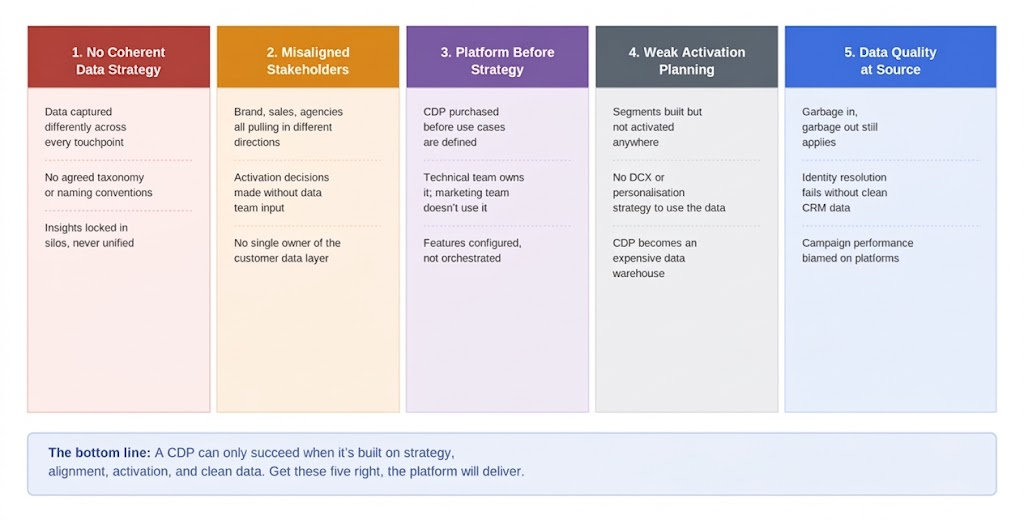
▲ The five most common CDP failure modes.
No Cohesive Strategy Across Touchpoints
The most fundamental failure mode is attempting to unify data that was never captured consistently in the first place. If your website captures email addresses in one format, your CRM uses a different identifier, your app tracks anonymous device IDs, and your retail locations have no digital capture at all, the CDP cannot magically resolve these into coherent profiles. Identity resolution requires something to resolve: a common thread, a shared identifier, a consistent taxonomy across the sources you are trying to join.
This is particularly acute in complex business structures. In the automotive sector in the GCC, for example, the typical structure involves the original manufacturer, independent dealerships within each market, and separate digital agencies managing different parts of the customer journey. Each layer may be capturing data differently, storing it in different systems, and operating with different definitions of what a 'customer' or a 'lead' actually is. A CDP layer cannot fix that structural misalignment; it can only expose it more expensively.
This is also why a full CDP is usually the wrong place to start. “Making Sense of Your Data Stack” covers the CDP-lite approach worth trying first.
Platform Before Strategy
The second most common failure is procuring the CDP before the use cases are defined. An organisation signs a multi-year contract with a major CDP vendor, begins a lengthy implementation project, and somewhere in the middle of that project, often twelve months in, somebody asks the question that should have been asked first: what exactly will we do differently once this is live?
The answer to that question needs to exist before the contract is signed, not after. Every use case, be it lead nurture, media suppression, lookalike modelling, personalisation, loyalty programme activation and so on, has specific data requirements, integration dependencies, and campaign workflow implications. Without knowing what you are building towards, you have no basis for making the dozens of configuration decisions that a CDP implementation requires.
Misaligned Stakeholders
CDPs touch more teams than any other marketing technology. The data team builds the segments. The media team activates them. The CRM team manages the lifecycle. The technology team owns the integrations. The digital agency manages the channels. In large organisations, these teams may have different objectives, different reporting lines, and different definitions of success.
When these teams are not aligned before implementation begins, on data ownership, on segment definitions, on activation rights, on measurement methodology etc., the CDP becomes a source of internal conflict rather than a source of intelligence. The platform sits in the middle of a political problem it was never designed to solve.
Most businesses ask 'which CDP should we buy?' before they have honestly answered whether they are organisationally ready to use one.
What A Working Implementation Looks Like
The implementation I will walk through here was for a leading luxury automotive brand operating across ten markets in the Middle East and North Africa. The complexity was significant: a multinational OEM structure, multiple dealership networks, uncoordinated media partners, a fragmented technology stack, and an advanced CDP platform that required substantial enablement before the client team could use it independently.
The Starting Point
The data landscape before implementation was fragmented in every direction. Ten separate market websites with inconsistent tracking. Salesforce CRM holding lead data with no connection to digital behaviour. Adobe Analytics capturing web events with no CRM enrichment. Media platforms running campaigns against basic demographic targeting with no behavioural signal. No Dynamic Creative Optimisation. No suppression of existing customers from acquisition campaigns. No lookalike modelling against high-value customer profiles.
The fundamental problem was not that the data did not exist. It was that the data existed in silos that could not talk to each other, which meant every channel was making targeting decisions based on an incomplete picture of each customer.
What We Built
The implementation had three phases. The first was data integration: ingesting and harmonising data from the ten websites, the Salesforce CRM, and Adobe Analytics into unified user profiles within the CDP. This is where the identity resolution work happened: matching web visitors to CRM records, resolving cross-device behaviour, and building the foundation that everything else depended on.
The second phase was audience intelligence: developing approximately one hundred advanced audience segments using behavioural, transactional, and inter-personal attributes, with a proprietary lead scoring model layered on top. The segments ranged from high-intent in-market buyers to existing owners at different stages of their ownership cycle to lapsed prospects who had previously engaged but not converted.
The third phase was activation: taking those segments into the media ecosystem. Audiences were activated across Meta, Google DV360, and CRM channels, with a Dynamic Creative Optimisation strategy that served different creative executions to different segments across all ten market websites. For the first time, the brand could show different messaging to someone who had configured a specific model three times versus someone who had visited the homepage once.
Some Use Cases

Lookalike modeling takes your best existing customers, builds precise audience segments from your first-party data, and sends those segments to media platforms. Each platform then finds new users who match the same behavioural and demographic patterns, thereby extending your reach to people you've never targeted but who look like the ones already buying.
The quality of the output depends entirely on the quality of the seed data. Fragmented CRM records or unresolved customer identity produces noisy seed audiences, and noisy seed audiences produce poor lookalikes. It's a direct line from data maturity to media efficiency.

Cross-sell retargeting targets customers who have recently made a purchase and reaches them with relevant follow-on offers before their post-purchase engagement window closes.
The CDP identifies recent purchasers in the CRM and splits them into three distinct audiences based on what they're most likely to need next: accessories, service plans, or a loyalty programme. Each audience then receives tailored communication through email automation (triggered sequences tied to the purchase event) and web personalisation (on-site content and offers adapted to their purchase profile).
The logic is straightforward: a customer who just bought is already in a buying mindset and has demonstrated trust. The moment to offer complementary products is immediately after the transaction, not months later. The CDP makes this precise rather than broadcast, ensuring the right offer reaches the right customer rather than promoting everything to everyone.

Cart abandoner reactivation targets users who added a product to their cart but left without buying. The CDP detects the abandonment event in real time, enrolls the user in a re-engagement audience, then applies a 7-day wait before activating, giving the user a chance to return organically first.
The critical element is the suppression logic: if the user purchases during the wait window, they are automatically removed from the audience before any re-engagement message fires. This prevents the jarring experience of receiving "you left something behind" emails for a product you've already bought, a common failure when suppression isn't built into the rule.
Non-converters after 7 days receive a triggered email sequence and see personalised on-site content surfacing the abandoned item, nudging them back toward the purchase they already showed intent for.
The Results

▲ Implementation results across 10 markets. Lead conversion rate doubled in KSA and Dubai, media engagement increased 60%, and activation cost reduced by two thirds, driven by smarter audience targeting rather than increased spend.
The most commercially significant result was the 3X reduction in activation cost. This did not come from spending less, but it came from spending more precisely. When you can suppress existing customers from acquisition campaigns, build lookalike audiences from your highest-value converters, and serve relevant creative to in-market prospects rather than everyone who has ever visited a website, the same budget goes further.
You Do Not Need Ten Markets To Get Results
The automotive implementation is a large-scale example. It is useful for demonstrating what is possible, but it can create a misleading impression that CDPs are an enterprise-only technology requiring significant budget and complexity to justify.
A more modest implementation I worked on (a single-market deployment for a consumer brand at a much smaller scale) produced a 2.5X uplift in revenue from the activated segments and approximately 30 percent reduction in campaign costs within the first activation cycle. The scope was narrower, the budget was smaller, and the implementation was faster. The fundamental mechanism was the same: unify the data, build the intelligence, activate it consistently.
The lesson is not that you need a ten-market rollout to justify a CDP. It is that the underlying principle of knowing your customer well enough to treat them differently based on what they have done, creates value at any scale. The platform enables that at scale. At smaller scale, the same outcome is sometimes achievable with simpler tools and the right strategy.
Strategy is the prerequisite, not scale. A clear use case and clean data will outperform a sophisticated platform with neither.
Are You Ready For A CDP?
Before evaluating platforms, pricing, or vendors, the more important question is whether your organisation is ready to use one effectively. Based on the implementations I have been involved in, here is a six-point readiness check.

▲ CDP readiness: six questions to answer before you invest in a CDP
If you cannot answer yes to at least four of these six questions, procuring a CDP will not solve your problem. It will make it more visible, more expensive, and harder to address under the pressure of an implementation timeline. The right sequence is: resolve the strategy and data questions first, then evaluate the platform.
What This Means For Your Business
- Audit your data capture before evaluating platforms. Walk every customer touchpoint, both digital and physical, and document what data is captured, how it is stored, and what identifier links it to your other sources. This exercise alone will tell you whether you are ready for a CDP or whether there is foundation work to do first.
- Define your use cases before signing a contract. Be specific. Not 'better targeting', but 'we will suppress existing customers from acquisition campaigns, build lookalike audiences from our top 10% of buyers, and serve personalised creative to in-market prospects.' Specific use cases drive specific configuration decisions. Vague ambitions drive expensive customisation and scope creep.
- Solve the stakeholder alignment problem before the technology problem. If your marketing, data, technology, and agency teams are not aligned on data ownership, segment definitions, and measurement methodology, the CDP will surface that misalignment rather than resolve it. The political work is harder than the technical work. Start there.