
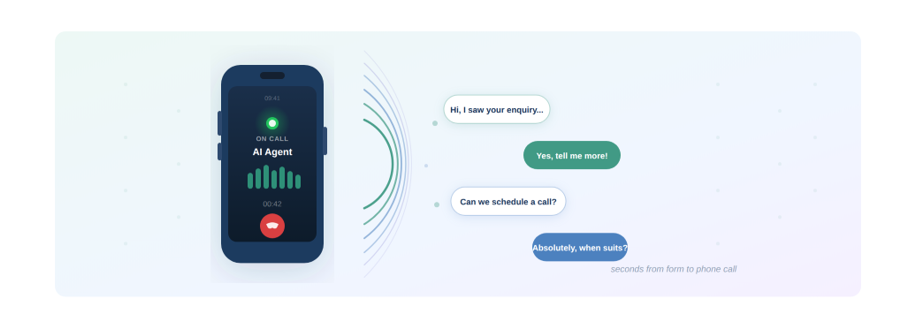
Last year, I built a system that cold-called leads, introduced itself as an AI agent, asked personalised questions based on the prospect’s form submission, handled objections, and logged the entire conversation as structured data in a CRM. The interaction quality was good enough that a number of people assumed they were talking to a human. The cost per call was less than the price of a text message. The system ran without a human in the loop. That was not a demo. It was a production build, and it is one of three voice AI systems I put into operation during the fellowship.
Voice has always been the most natural human interface. It was also one of the hardest for AI to get right, not because the technology arrived last, but because real-time conversation leaves no room for the pauses and corrections that make text and image generation forgiving. A language model that thinks for two seconds before responding is unacceptable in a phone call in a way it never is in a chat window. That threshold has now been crossed in a way that is practically useful. Not perfect. Practically useful.
How Voice AI Actually Works
There are three layers in any voice AI system. The first is Automatic Speech Recognition: the conversion of spoken audio into text. This is where dialect variation, accent, background noise, and language choice create the first point of failure. The second layer is the Language Model, which processes the transcribed text, reasons about it, and generates a response. This is where intelligence lives and where most of the cost sits. The third layer is Text-to-Speech Synthesis: converting the generated response back into audio that sounds natural and human.
Voice cloning adds a fourth layer between the language model and the speech output: instead of a generic synthetic voice, the system speaks in a specific person’s voice by capturing their tone, cadence, pace, and speech patterns. Voice agents combine all four layers into a conversational system that can hold a real-time telephone or digital conversation, respond dynamically, and take actions based on what is said.

Build 1: Cloning The Soul And The Body
The most conceptually interesting of the three fellowship builds was voice cloning, and the framework that made it click was thinking about it in two distinct layers: the soul and the body. The soul is the voice, the acoustic identity, the cadence, the emotional register that makes a voice recognisably yours. The body is the visual layer: the avatar, the facial movements, the physical presence that accompanies speech when the output is video rather than audio alone. These two layers are produced by different tools, connected through an API handshake, and combined in post-production. Getting either layer wrong produces uncanny results. Getting both right produces something that is genuinely useful.
For the voice layer, ElevenLabs is the industry standard. Two tiers of cloning are worth understanding. The Instant Voice Clone takes a short audio sample and produces a reasonable approximation within seconds, the barrier to entry is low, but so is the fidelity. You get the broad strokes of a voice without the nuance. The Professional Voice Clone requires between ten minutes and two hours of clean audio, and produces a clone that captures specific mannerisms, breath patterns, and tonal variation with enough accuracy to be convincing in extended use. The quality principle that applies to both tiers is one that recurs across AI: Garbage In, Garbage Out. A Professional Voice Clone built from badly recorded, inconsistent audio will be a worse output than an Instant Voice Clone built from excellent source material. The tool is only as good as what you feed it.
For the visual layer, HeyGen handles both text-to-video generation and digital avatar creation. The process involves recording video footage that meets specific requirements (resolution, lighting, visibility discipline, centred framing, varied facial expressions) that the model uses to learn how the face moves and how movement connects to speech. The avatar can then be animated from text input, with new audio driving lip sync and facial movement. The consent process in HeyGen is explicit and deliberate, which matters given the misuse potential of the technology. What the combined system produces is a speaking digital twin that looks and sounds like a specific person, which is both genuinely useful for content creation at scale and a clear illustration of why the ethical dimension of voice AI is not a theoretical concern.

Build 2: The Outbound Voice Agent
The second build addressed a problem that costs businesses significant revenue every year: speed to lead. Research on service industry conversion rates consistently finds that the probability of converting a lead drops dramatically with response time; a prospect who submits a form and receives a call within five minutes is orders of magnitude more likely to convert than one who waits an hour, regardless of how good the follow-up call is. For most businesses, the gap between form submission and human call-back is measured in hours, not minutes. An AI voice agent closes that gap to seconds.
The architecture is straightforward once you understand the components. A form submission triggers a webhook, which passes structured data to N8N as the orchestration layer. N8N formats the payload and sends it to VAPI, the voice AI platform that handles telephony, connects to the language model, and manages the conversation in real time. The agent initiates the call within seconds of the form submission and conducts a personalised conversation using dynamic variables: the prospect’s name, their enquiry type, specific details from the form they submitted. From the prospect’s perspective, they submitted a form and their phone rang almost immediately with an agent who already knew why they were calling.
The distinction between high context and low context agents is what separates this kind of build from a basic chatbot. A low context inbound agent knows nothing about the caller until they start speaking, and its job is discovery. A high context outbound agent knows exactly who it is calling and why, which means the conversation can skip the discovery phase entirely and move directly to qualification and next steps. This changes the prompt engineering significantly. A high context prompt specifies not just the agent’s role but the customer context, the personalisation variables, the conversation flow, and the specific outcomes the call is designed to produce. The quality of that prompt determines whether the agent sounds intelligent and purposeful or confused and generic.
In testing, what stood out was how well the agent held context; it did not just read from a script but gave answers that were genuinely relevant to what the lead had asked, drawing accurately from the information it had been given about them.
Build 3: When AI Interviews The Candidates
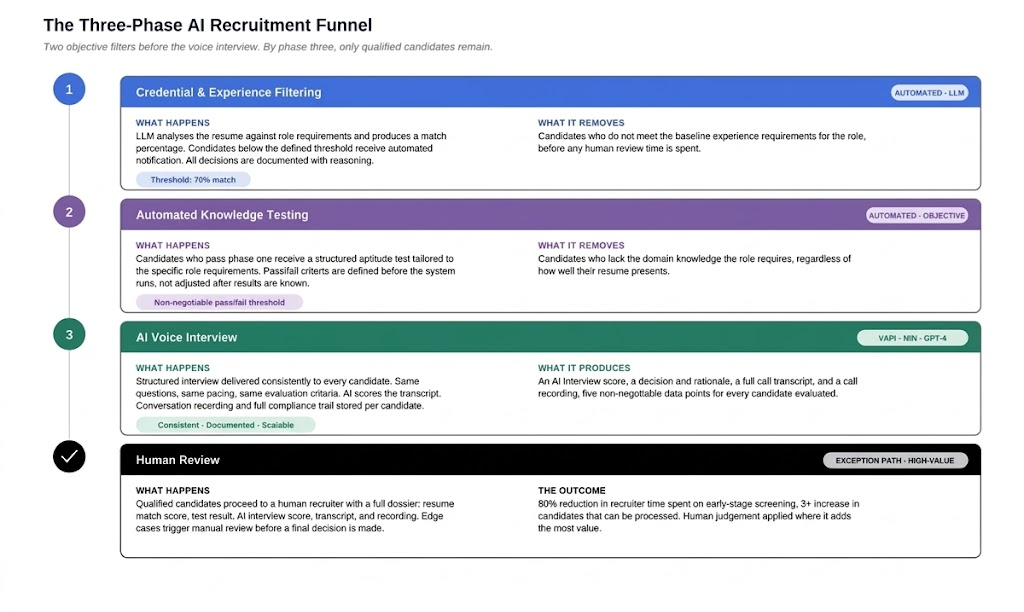
The most complex of the three builds was an autonomous recruitment system that reduces human involvement in the early stages of candidate evaluation by approximately 80% while increasing the volume of candidates that can be processed. The system runs three sequential phases before a human recruiter is involved, and the voice interview is the third and final filter.
Phase one is credential and experience filtering. When a candidate submits an application, a large language model analyses the resume against the role requirements and produces a match percentage. Below a defined threshold, 70% in the implementation, the candidate receives an automated response explaining that their application was not progressed. This is not a rejection based on arbitrary criteria; it is a structured assessment against the specific requirements of the role, with a documented audit trail of the reasoning.
Phase two is an automated knowledge test specific to the role. Candidates who pass the resume threshold receive a structured test that assesses the domain knowledge the role requires. The pass or fail criteria are defined before the system runs, not adjusted post-hoc. By the time a candidate reaches phase three, they have cleared two objective, documented filters. The voice interview is not doing the work of basic qualification, rather it is doing the work of assessment.
Phase three is the AI voice interview, delivered through VAPI connected to a language model via N8N. The interview runs to a consistent structure, asks the same questions with the same pacing for every candidate, and produces a transcript and an AI-evaluated score. Consistency is one of the strongest arguments for AI interview systems: every candidate gets exactly the same experience, with no variation in question quality based on interviewer mood, fatigue, or unconscious preference. The transcript and recording are stored against a defined set of data points that form the compliance trail for every decision made by the system.
In testing, the first challenge was latency, a noticeable lag between the candidate’s response and the agent’s next question. This was resolved by switching to a lighter, lower-latency model configuration, which brought the response time within the range that feels natural in conversation. Once that was addressed, the interaction quality was genuinely impressive: the conversation flowed, the agent handled unexpected responses without breaking, and the output (the transcript and the structured evaluation) was of production quality. Human reviewers are built into the system as an exception path for candidates who score in edge-case ranges, preserving human judgement for the decisions where it matters most.
The GCC Dimension
The UAE alone has over 200 nationalities. A typical customer-facing team in Dubai might include Emirati Arabic speakers, Indian and Pakistani professionals speaking English as a second language, Filipino service staff, and European or North American managers, all within the same organisation. For voice AI, this is both an opportunity and a constraint. The opportunity is significant: multilingual voice interactions at scale, consistent service quality across languages, and the ability to match voice agent language to customer preference in real time. The constraint is equally significant: voice AI that performs well in standard American or British English frequently degrades significantly in non-native accents, dialectal variation, or code-switching; the natural mixing of languages within a single conversation that is common in the Gulf.
Arabic presents a specific challenge that goes beyond accent. The gap between Modern Standard Arabic, the formal written form used in media and official communication and Gulf Arabic dialects spoken in everyday conversation is significant enough that models trained on one will perform poorly on the other. This was evident in a customer service AI deployment in the region where intent detection failed specifically on Gulf Arabic input, requiring retraining before the system could operate reliably. WhatsApp voice notes add another dimension: they are a primary business communication channel across the GCC, and they combine casual register, dialect variation, background noise, and abbreviated speech in ways that stress-test ASR systems considerably. Building for voice in this market requires explicit decisions about which languages and dialects to support, not an assumption that English performance will transfer.
What Voice AI Reliably Delivers And Where It Still Falls Short
Based on the three builds, structured outbound calling with high context is where voice AI delivers the most reliable value. The agent knows who it is calling, why it is calling, and what outcome it is trying to produce. The conversation is bounded enough that the language model can navigate it without improvising in ways that produce failures. Lead follow-up, appointment scheduling, post-purchase check-ins, and structured interviews are all strong use cases for this reason.
The limits appear in three places. The first is unstructured inbound conversation, where the caller can say anything about anything, and the agent has no context to anchor its responses. This is solvable with good prompt engineering but remains harder than outbound. The second is language and dialect variation, particularly for Arabic, which is an unsolved problem at the quality level that production deployment requires. The third is emotional nuance at extended range; voice AI handles the emotional register of a professional call well, but longer conversations that require sustained empathy, reading between the lines, or responding to distress still benefit from human involvement.
The Ethical Obligation That Comes With The Capability
Voice cloning and voice agent technology is dual-use in the most direct sense. The same technology that automates a lead follow-up call can create a convincing impersonation of any person whose voice can be sampled. The same system that conducts structured interviews can be used to place calls that misrepresent who is calling and why. Disclosure, or the explicit identification of an AI agent at the start of a conversation, is both an ethical requirement and, in a growing number of jurisdictions, a legal one. The compliance trail built into this recruitment system reflects the same principle applied to data: every decision the system makes is documented, accountable, and auditable.
The terms of service for ElevenLabs, HeyGen, and VAPI all include explicit consent and disclosure requirements. Building with these tools responsibly means understanding what those requirements are and designing systems that meet them, not treating them as fine print to be addressed if something goes wrong. The technology is moving fast enough that regulatory frameworks are still catching up; but the ethical standards are clear regardless of whether the legal requirement has arrived yet.
Where This Is Heading
The half-life of knowledge in voice AI is short. The latency problems that required model changes during testing of the recruitment system are being addressed by every major voice platform as a competitive priority. Arabic and multilingual support is improving measurably with each model generation. The cost per interaction, which is already lower than a human call by an order of magnitude, will continue to fall. The builds described here represent what was achievable in 2025 with available tools; the equivalent builds in 2026 will be faster, cheaper, and more linguistically capable.
What will not change is the fundamental design discipline required to deploy voice AI responsibly: understanding what the system is doing and for whom, building in the human oversight that edge cases require, and being explicit with the people who interact with it about what they are talking to. Voice AI that performs well and is deployed responsibly is a significant capability advantage. Voice AI that performs well and is deployed carelessly is a liability waiting to surface.
Voice AI sits high on my list of capabilities I actively take into client conversations, the use cases across marketing, operations, and customer service are concrete enough to translate immediately into business cases, and the gap between what most organisations are doing with it and what is already possible is wide enough that early adopters will have a meaningful head start. That gap is also, candidly, where the consulting opportunity sits.