
Picture the opening of a typical senior leadership meeting. The agenda item is customer retention. Three people are presenting: one from marketing, one from finance, one from CX. They each bring data. Within five minutes, the discussion has shifted from retention strategy to which number is correct. The meeting ends having resolved neither question. This happens everywhere. Most organisations recognise it. Most assume it is a data quality problem. It is a data maturity problem, and the distinction matters enormously for what you do about it.

The Definition That Actually Works
Data maturity is one of those terms that accumulates meaning until it means nothing. Analysts use it to sell assessments. Vendors use it to frame transformation proposals. So let us strip it back. The simplest useful definition: data maturity is how reliably an organisation can turn data into operational decisions and measurable business action. Not dashboards. Not infrastructure. Not AI pilots. Decisions and action.
A mature organisation is not necessarily the one with the most advanced stack. Research on data-driven organisations consistently finds that the performance differential between mature and immature organisations comes from activation, which is the data that reaches the point of decision and not from the sophistication of the infrastructure behind it. Organisations where data actively shapes commercial decisions outperform peers on revenue growth, retention, and efficiency regardless of the size of their technology investment. The platform is not the maturity. The changed decision is.
Operationally, maturity shows up in specific, observable behaviours that have nothing to do with which platforms you own. Meetings do not start with 'whose numbers are correct?' because shared definitions mean there is one version of the truth. Frontline teams check data before making campaign or pricing decisions, not after. Experiments are repeatable: the organisation can run, measure, and act on tests systematically rather than one-off. Customer identity is reasonably resolved across channels. CSV exports and manual reconciliations have become the exception rather than the default.

Why The Region Has A Specific Version Of This Problem
Regional data and AI investment is accelerating. IDC's Middle East data shows that data and AI investment across the region grew by over 20% year-on-year through 2023 and 2024, with the UAE and Saudi Arabia leading both in volume and ambition. The UAE has targeted digital economy contribution rising from 9.7% of GDP in 2022 to over 20% by 2031, per the UAE's own Digital Economy Strategy. The executive will is real and the investment is following it.
But PwC Middle East's 2024 Digital Transformation Survey found that over 60% of regional executives cite data quality and fragmentation as their primary barrier to realising AI value, even among organisations that have already made substantial platform investments. And analysis of digital transformation outcomes in the Middle East consistently finds that a majority of initiatives underdeliver on the value case originally made for them, with data immaturity cited as a primary cause.
Two dynamics specific to the region make this particularly acute. The first is what might be called transformation leapfrogging: regional organisations frequently attempt advanced AI and personalisation before mastering governance, identity resolution, and process standardisation. The ambition moves faster than the operating model can follow. The second is how maturity gets measured. In more established markets, maturity benchmarks tend to be internal and outcome-focused: does the team run experiments independently? Do frontline teams use data before decisions? In the region, maturity is more often measured against technology acquisition like platform modernisation, AI initiative launches, transformation announcements. The SDAIA's National Data Management Office in Saudi Arabia has been developing data governance frameworks specifically to close this gap, recognising that infrastructure investment without governance and adoption does not produce the outcomes that justify it.
Executive ambition is a genuine competitive advantage in the region. The gap is not in will or investment. It is in the operating model changes that translate that investment into changed decisions at the frontline.
The False Confidence Trap
The most common maturity miscalibration is equating reporting visibility with operational maturity. A business has cloud dashboards, executive scorecards, modern BI tooling, and regular KPI reviews. The data team is active and visible. Leadership reasonably concludes the organisation is data-driven. That confidence tends to hold until the organisation attempts something operationally demanding: not reporting on what happened, but using data to change what happens next. Personalisation at scale. Churn prediction. Loyalty programme redesign. AI deployment across a customer-facing channel.
What the test reveals is consistent regardless of industry or geography: customer IDs do not match across systems, KPIs are defined differently by different departments, historical data quality is too poor to train reliable models, and nobody has clear accountability for resolving the conflicts that surface. The dashboards looked like evidence of data capability. They were evidence of reporting investment, a related but meaningfully different thing.
Gartner's analysis of data and analytics maturity consistently finds that organisations overestimate their maturity by approximately one stage when self-assessing, particularly on governance and operational adoption. The gap between self-reported and assessed maturity is largest in organisations that have made significant infrastructure investments, because the infrastructure creates visible evidence of capability that is mistaken for operational maturity. The test that matters is not: do we have data on this? It is: did the data change what we did? If the honest answer is no; if the insight stayed in the presentation, then the maturity is not there yet, regardless of the infrastructure behind it.

The Five Stages And Where To Locate Yourself
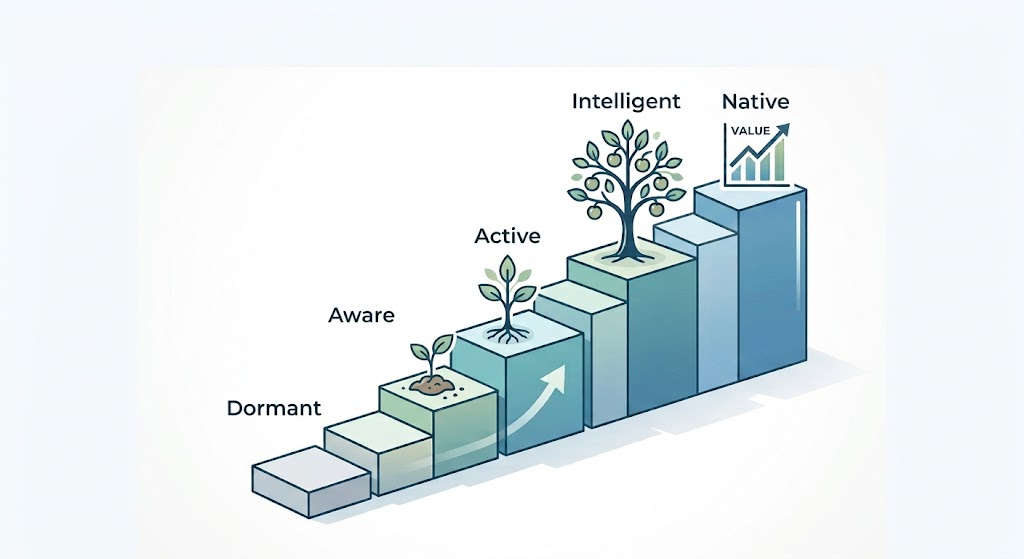
The maturity model I use across client engagements maps the journey across five stages. The stages describe not just what an organisation can do technically, but how it thinks about and acts on data, which is what actually determines the outcome. A fifth stage has been added to the traditional four-stage framework specifically to account for where AI sits in the maturity progression, because the stage you are at determines what AI can reliably do for you.
This is the fuller model behind the four-stage AI readiness lens used in “Why AI is Only as Good as Your Data.” That post applies it specifically to AI; this one covers the organisational maturity underneath it.→
Stage 1, Data Dormant, is characterised by the mindset: we know data matters, but we are not using it. Data exists: in a CRM, in spreadsheets owned by individuals, in platform dashboards nobody reconciles; but access is limited and organisational trust in internal numbers is low. AI capability here is essentially none.
Stage 2, Data Aware, describes the most common stage among well-resourced regional enterprises. Digital tracking is good, dashboards exist, the CRM is active, but the data lives in functional silos that do not connect. Marketing's ROAS, Sales' pipeline, and Finance's revenue have never reconciled and everyone has quietly accepted that they never will. Off-the-shelf AI tools work at this stage. Custom AI does not.
Stage 3, Data Active, is where genuine analytical value unlocks. Reporting is tied to business objectives, not channel metrics. There is a single agreed definition of a customer and a single agreed source of truth. Different functions look at the same data. Governance and data ownership are clear. This is the stage that enables RAG systems, segmentation models, and attribution analysis that actually changes how budget gets allocated.
Stage 4, Data Intelligent, is where predictive capability emerges like marketing mix modelling, churn prediction, advanced personalisation, recommendation engines. The data is clean, unified, and historically rich enough to train models that produce decisions rather than dashboards.
Stage 5, Data & AI Native, is where AI is embedded in operational decisions rather than sitting alongside them, systems improve automatically as more data flows through them, and the organisation makes decisions it genuinely could not have made before.
Where Most Regional Organisations Stall
Moving from Stage 2 to Stage 3 is the hardest transition in the model. It is also the most misunderstood. Most organisations that are stuck at Stage 2 diagnose themselves as having a technology problem, when the real problem is organisational, and buying new technology to solve it is one of the most expensive mistakes a data function can make. The tools most organisations have at Stage 2 (a CRM, a marketing automation platform, analytics) are sufficient to reach Stage 3. The blocker is governance, ownership, and the organisational will to define a single source of truth and defend it.
The pattern is consistent. Marketing has a ROAS dashboard. Sales has a conversion dashboard. Finance has a revenue dashboard. Each measures a version of the same commercial activity and produces different numbers. The CFO has learned, through repeated experience, that the marketing metrics and the finance metrics will not agree and has stopped expecting them to. Nobody is lying. Everybody is working with the best data they have. But nobody has done the hard, unglamorous work of defining a single metric, agreeing on a single attribution logic, and holding every function to the same number. The question of who owns this reconciliation is where the transition stalls, because marketing owns the marketing data, sales owns the CRM, finance owns the ERP, and nobody has the mandate or incentive to sit in the middle and solve the cross-functional problem.

Assess Yourself Honestly: Six Dimensions
Data maturity is not a single score. Most organisations are more mature on some dimensions than others. The six-dimension self-assessment below is designed to be used dimension by dimension and the point is to identify where the genuine gaps are, not to produce an overall score that averages them away.
One important note before using it: the assessment should reflect current operational reality, not intended future state. A governance framework that has been written but is not enforced is not a mature score. An identity project underway but not yet producing a unified record is not mature. The discipline is in being honest about what is actually happening today.

The six dimensions are deliberately chosen because each one creates a specific constraint on what AI and data can reliably do. Without customer identity resolution, personalisation and churn modelling are working on fragments rather than customers. Without metric consistency, AI models are trained on contested definitions of business success. Without operational adoption, insights stay in presentations and never reach the point of decision. Without data governance, data conflicts have no resolution mechanism and accountability is absent. Without activation capability, data that exists cannot reach the systems that act on it. Without experimentation culture, there is no way to know whether data investments are actually working.
Most organisations find they score Early Stage or Developing on at least three of these dimensions. That is not a failure; it is an honest baseline. The value is in knowing which three, because those are the constraints that most directly limit what AI can do in the near term.
Technically Modern. Operationally Immature.
This is the phrase that best captures the most common state of regional data organisations in 2026. It is not a criticism, but it is a description of where significant infrastructure investment, rapidly advancing executive ambition, and constrained operational change management have produced a predictable gap. The organisations that are closing it share a recognisable set of characteristics: data governance has moved from a policy document to a named accountability; customer identity is resolved or actively being resolved across at least the primary channels; there is one or more business decisions that are made differently, measurably differently, because of data; and the outcomes of data investments are measured, not just their scale.
Analysis of high-performing digital organisations in the UAE points to operational adoption and governance accountability as the two variables most predictive of sustained data programme performance, which is ahead of technology sophistication, data team size, or AI investment. The organisations that perform best changed how decisions get made, not just how much they invested in platforms.

Three Moves That Actually Change The Score
There is no shortage of data maturity frameworks. Most are comprehensive, logical, and completely disconnected from how change actually happens inside organisations. The three moves below are not a framework, they are the specific interventions that consistently unlock progress on the dimensions that matter most.
1. Pick One Decision And Make It Data-driven. Completely.
Not ten decisions. One. Identify a business decision that is currently made by intuition, historical precedent, or whoever is most senior in the room; be it a pricing call, a campaign targeting decision, a customer tier classification and so on. Build the data flow that supports it in near-real-time. Hold the team accountable for using it. Measure whether decision quality improved. This sounds trivially small. It is not. It demonstrates, inside the organisation, what operational maturity actually feels like and creates internal demand for more of it. The organisations that make the fastest maturity progress almost universally describe a single early win that changed internal appetite.
2. Resolve One Identity Problem. Completely.
Not all of them. One. The highest-value customer identity gap, the one that sits upstream of the most use cases, is usually the link between the CRM and one other major channel. Resolve it. Build the join. Activate the unified record in one campaign or service interaction. Show what is possible when the AI is working from a coherent customer rather than a fragment. Identity resolution at enterprise scale is a multi-year programme. Identity resolution for one meaningful customer segment in one channel combination is a quarter of work. Start there.
3. Name One Data Owner. With Actual Accountability.
Governance frameworks that are not enforced do not change maturity scores. What changes them is accountability: a named person responsible for a specific data domain, with the authority to resolve definition conflicts, and whose performance is partly assessed on data quality outcomes. Start with the KPI that causes the most meeting conflict. Name the owner. Give them the authority. Measure whether the conflict reduces. Then repeat for the next domain. Governance built incrementally with real accountability outperforms comprehensive frameworks that nobody enforces.
Data maturity is not a destination reached by investing in the right platforms. It is a capability built by changing how decisions get made, one decision at a time, with accountability for whether it worked.