
“LLMs & Prompt Engineering” covered what large language models are, how they work, and how to get better outputs through effective prompting. But there is a fundamental limitation that post only touched on: LLMs do not know your business. They know the internet. And there is a significant difference between the two.
RAG or Retrieval Augmented Generation, is the architecture that closes that gap. It is how you take a general-purpose language model and ground it in your specific knowledge. And it is, arguably, the single most commercially relevant AI concept for businesses right now.
Why it matters: Most successful AI applications being built today are not sophisticated new models; they are well-executed RAG systems. The intelligence is in the retrieval. The foundation is in the knowledge base.
Why RAG Exists: The Problem With Out-of-the-Box LLMs
If you have used a general AI assistant at work and noticed that it sometimes confabulates or gives you a confident, fluent, entirely wrong answer, you have experienced the core limitation RAG is designed to address.
LLMs have several structural weaknesses that make them unreliable for business-critical applications on their own:
- Knowledge cutoff: the model only knows what was in its training data, which has a fixed endpoint
- Hallucinations: when uncertain, models generate plausible-sounding text rather than admitting ignorance
- No access to your data: the model has never seen your policies, products, pricing, or processes
- Context limitations: even with a long context window, you cannot feed an entire knowledge base into every query
- No long-term memory: the model forgets everything between sessions
The French government learned this the hard way. In 2023, they launched an AI chatbot trained on general French language data at a reported cost of approximately 40 million euros. It was taken offline within 48 hours, not because it was unintelligent, but because it had no grounding in what it was supposed to know and do. It was a powerful model with no knowledge base and no grounding instructions. A well-structured knowledge base and a clear system prompt would have been among the foundational requirements. RAG is the architecture that provides both.
The contrast is instructive. Perplexity AI, one of the fastest-growing AI products globally, is essentially a well-executed RAG system. It retrieves current web content, grounds the LLM in that retrieved context, and produces cited, verifiable answers. The architecture is not complicated. The execution is.
What RAG Actually Is: Ask, Look, Answer
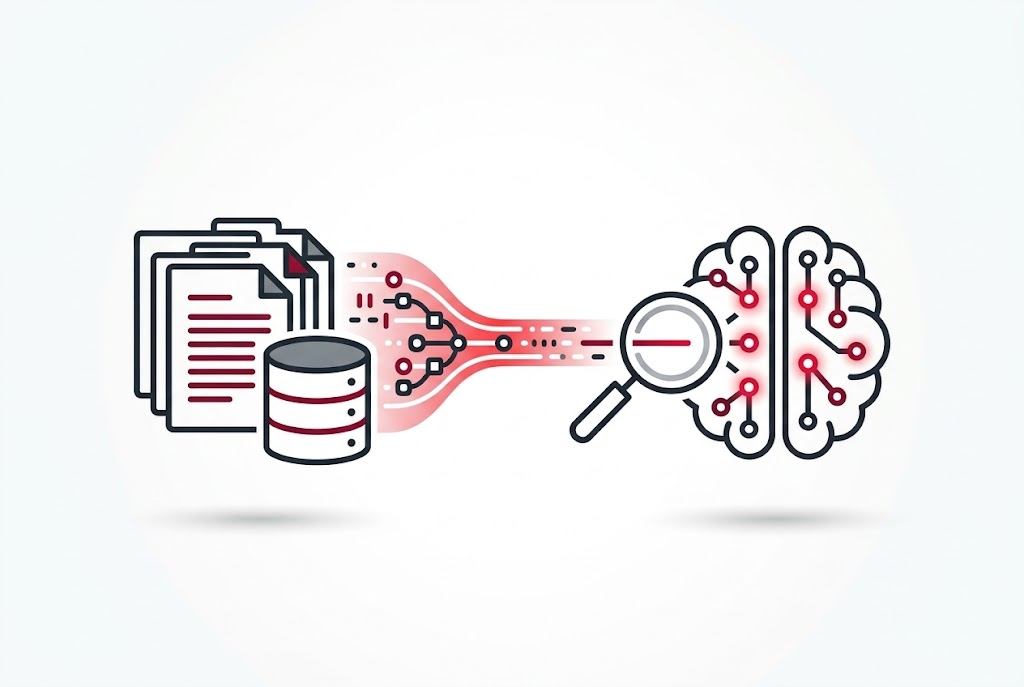
Retrieval Augmented Generation works exactly as the name suggests. Before the LLM generates a response, the system retrieves relevant information and gives it to the model as context. The model then generates an answer grounded in what was retrieved, not just what it was trained on.
The simplest way to think about it: imagine a very capable researcher who has access to a well-organised library. You ask a question. Before answering, the researcher goes to the library, finds the relevant books and articles, reads them, and then synthesises an answer. The LLM is the researcher. The knowledge base is the library. The RAG system is the librarian that knows where everything is.

What makes RAG powerful for business is the separation of concerns. The LLM handles reasoning and language generation, the capabilities that are expensive to develop and widely available. The knowledge base handles your specific domain expertise. You own and control the knowledge base. You do not need to retrain the model.
Where RAG Makes Business Sense
RAG is not the right architecture for every AI application. It is particularly well-suited to situations where:
- The knowledge is proprietary and specific: your policies, products, processes, or expertise
- Accuracy and consistency matter: customer-facing responses, compliance documentation, professional recommendations
- The knowledge changes: RAG knowledge bases can be updated without retraining the model
- The scope is bounded: a customer support assistant for your business has a knowable, finite knowledge domain
Real-world RAG applications that illustrate the range of what is possible:
- Bloomberg GPT uses RAG to ground financial analysis in current reports and filings
- JPMorgan uses RAG-based AI to surface relevant risk factors from legal and regulatory documents
- Harvey AI uses RAG across legal case law databases to support legal research
- Mayo Clinic's medical assistant retrieves from clinical guidelines before generating responses
- Shopify's AI assistants answer complex product queries by retrieving from store-specific knowledge
- In the GCC, government digital portals and regulated-industry platforms are deploying RAG to ground AI assistants in Arabic and English documentation like service regulations, compliance frameworks, and product catalogues etc., enabling accurate, multilingual responses without human intervention at scale
The pattern across all of these is the same: a powerful general model, grounded in a carefully curated domain-specific knowledge base. The secret is not the model. It is the knowledge.
How RAG Works: The Three Stages
Understanding how RAG works technically, even at a high level, is important because the decisions you make at each stage directly affect quality. Poor indexing produces irrelevant retrieval. Irrelevant retrieval produces hallucinations. Good RAG requires deliberate choices at every step.

Stage 1, Indexing: Organising The Knowledge
Before any retrieval can happen, your knowledge base needs to be prepared. Document formats such as PDFs, websites, spreadsheets, policy documents are broken into smaller chunks. Each chunk is then converted into a vector embedding: a numerical representation of its meaning rather than just its keywords.
These embeddings are stored in a vector database. When a user query arrives, it is also converted to a vector, and the system finds the chunks whose vectors are closest in meaning to the query vector. This is semantic search, finding what is relevant by meaning, not just matching keywords.
Plain English: Your documents are turned into numbers that capture their meaning. The system finds which numbers are closest to your question's number. That is vector search.
Plain English: Your documents are turned into numbers that capture their meaning. The system finds which numbers are closest to your question's number. That is vector search.
Stage 2, Retrieval: Finding What Matters
The retriever acts as the system's librarian. It takes the user's question, searches the vector database, and returns the most semantically relevant chunks. These chunks become the context that gets passed to the LLM.
Retrieval quality is where most RAG systems succeed or fail. Retrieve irrelevant chunks and the model generates irrelevant or hallucinated answers. Retrieve the right context and the model can produce highly accurate, specific responses that would be impossible without that grounding.
Stage 3, Generation: Crafting The Answer
The LLM receives an augmented prompt: the user's original question plus the retrieved context. It generates a response grounded in that specific context. The key difference from a standard LLM interaction is that the model is now constrained, albeit deliberately, to what it was given.
Done well, the model cites or references the retrieved information. Done poorly, the model ignores the retrieved context and generates from its training data anyway, which defeats the purpose. This is where prompt engineering and RAG intersect, and it is not a trivial design problem.
Building It: The AI Solution Advisor
The AI Solution Advisor, one of the three products I built during my AI fellowship, uses RAG at its core. The concept is straightforward: a business fills in a structured assessment about their needs, challenges, and context. The system then matches them to the most relevant AI tools and generates a detailed implementation proposal.
The knowledge base powering the retrieval contains over 200 AI tools, each documented across more than 25 dimensions: use cases, pricing, technical requirements, regional considerations, when to use it, and when not to. That depth of documentation matters; it is not enough to know that a tool exists. The system needs enough context to distinguish between, say, a no-code automation tool suitable for a solo operator and an enterprise integration platform with a six-month implementation timeline.
The knowledge base structure: Each tool entry captures: category, applicability (SMB/Enterprise/Both), USP, pros, cons, specific use cases, best-fit company profile, pricing tiers, technical requirements, GCC-specific considerations, and alternatives. 200+ tools. 25+ fields each. That is the retrieval substrate.
The knowledge base structure: Each tool entry captures: category, applicability (SMB/Enterprise/Both), USP, pros, cons, specific use cases, best-fit company profile, pricing tiers, technical requirements, GCC-specific considerations, and alternatives. 200+ tools. 25+ fields each. That is the retrieval substrate.
What Theory Does Not Tell You
Here is what I discovered in practice: RAG alone does not guarantee consistent output.
In the early iterations of the AI Solution Advisor, the retrieval was working whereby relevant tools were being retrieved, but the output was inconsistent. Ask the same question twice and you would get meaningfully different recommendations. The model was still exercising too much creative latitude. It was treating the retrieved context as a suggestion rather than a constraint.
The fix was not a change to the retrieval architecture. It was a change to the prompt. I had to explicitly instruct the model to stay grounded and to use only what was retrieved, to structure the output in a specific format, and to flag when the retrieved context was insufficient rather than interpolating.
The lesson: RAG and prompt engineering are not separate concerns. The quality of your retrieval sets the ceiling. The quality of your grounding instructions determines whether you reach it.
The lesson: RAG and prompt engineering are not separate concerns. The quality of your retrieval sets the ceiling. The quality of your grounding instructions determines whether you reach it.
The second lesson was about knowledge base quality. When I built the initial knowledge base with sparse tool descriptions, the retrieval returned relevant tools by category; but the generated recommendations lacked depth. The model would correctly identify that a company needed a workflow automation tool, but could not explain why one tool fit better than another for that specific context.
I had to rebuild the knowledge base with significantly richer entries, the kind of nuanced, comparative detail that a knowledgeable consultant would draw on. Once the knowledge base was comprehensive, the quality of the output transformed. The model did not get smarter. The retrieval got better.
The principle: A RAG system is only as good as the knowledge base behind it. Garbage in, garbage out, but the garbage is not always obvious at the retrieval stage. It shows up in the generated output as shallow, generic, or inconsistent responses.
The principle: A RAG system is only as good as the knowledge base behind it. Garbage in, garbage out, but the garbage is not always obvious at the retrieval stage. It shows up in the generated output as shallow, generic, or inconsistent responses.
What You Control & What You Do Not
One of the most useful frameworks for thinking about this is the distinction between what you can and cannot control in a RAG system. It maps directly to a classic management concept: circles of concern versus circles of influence.

Your Circle of Concern includes how the base model was trained, its inherent hallucination tendencies, and the architecture of the embedding model. These are real problems, but they are not yours to solve.
Your Circle of Influence, the four variables that determine the quality of your RAG system are:
- Purpose and system prompt: the clearer and more specific your instructions, the more constrained and consistent the model's behaviour
- Knowledge base quality: the depth, accuracy, and structure of the information you index determines the ceiling on output quality
- Choice of LLM: different models have different strengths; a model optimised for reasoning produces different results than one optimised for speed
- Choice of embedding model: different embedding models capture semantic meaning differently; the match between your content type and the embedding model matters
Of these four, knowledge base quality has the highest return on investment and is the most frequently underestimated. The temptation is to focus on model selection and prompt engineering while treating the knowledge base as a one-time setup task. In practice, it requires ongoing curation.
Understanding the failure modes is as important as understanding the architecture. RAG underdelivers in predictable ways. A knowledge base built from poorly structured or inconsistent source documents produces retrieval that is technically relevant but substantively thin: the right topic, the wrong depth. Retrieval tuned for broad recall returns too many chunks, diluting the context and giving the model too much to reconcile. And if the source documents contain contradictions or outdated information, the model will faithfully generate contradictions and outdated recommendations. The architecture does not validate what it retrieves. That is the builder’s responsibility. The practical implication is that knowledge base maintenance is not a one-time setup task, but an ongoing content operations discipline, and the quality of the output degrades in direct proportion to how seriously it is neglected.
Building RAG Without Writing Code
The tool landscape has matured to the point where RAG can be built without engineering resources, at least for personal and team-scale applications. The hard parts like embedding, vector storage, and retrieval are now abstracted away by purpose-built tools. What remains is the design work: defining the purpose, curating the knowledge base, and writing the system prompt.

Personal Use: MSTY And Dify AI
For individual exploration and personal knowledge assistants, MSTY allows you to run local models with your own documents privately and at zero cost. Dify AI offers a more structured RAG workflow builder with knowledge base management and chat interface, also suitable for solo exploration. Neither requires coding. Both require you to think carefully about what goes into your knowledge base.
Team Scale: VectorShift
VectorShift is designed for teams: shareable assistants, multi-user access, and an automated workflow that handles the indexing pipeline. Upload documents or connect data sources, configure the retrieval behaviour, and deploy a chat interface that colleagues can use without accessing the underlying configuration. The AutoRAG workflow handles chunking, embedding, and vector storage automatically.
Business Products: CalStudio
CalStudio targets commercial deployment, that is building RAG-powered assistants that can be embedded in websites or shared with clients. This is where the potential shifts from productivity tool to revenue-generating product. A knowledge base about your services, products, or domain expertise becomes the foundation of a client-facing AI assistant.
Key insight: The tools handle the engineering. What determines whether the output is useful or mediocre is the quality of the knowledge base and the clarity of the system prompt. Both of these are business decisions, not technical ones.
Before You Build: The Four Questions
Based on build experience across the AI Solution Advisor and the broader tool landscape, there are four questions worth answering before investing in a RAG system:
| Question | Why it matters |
| What outcome do I need? | Defines the system prompt and the scope of the knowledge base. A customer support assistant and a sales proposal generator have completely different retrieval requirements. |
| What will the model read before answering? | The knowledge base. Is it well-structured, comprehensive, and accurate? A sparse knowledge base produces generic responses. A deep one produces expert-level ones. |
| Which model fits this task? | Different LLMs have different strengths. A fast, lightweight model may be fine for simple FAQ retrieval. A reasoning-capable model is needed for complex recommendations. |
| How will I keep this grounded? | The system prompt and grounding instructions. Without explicit constraints, even a well-retrieved context gets ignored. Define what the model must do with what it retrieves. |
What This Changes
RAG reframes the AI conversation for business leaders in a useful way. The question stops being 'how do we train an AI on our data?', a multi-million dollar undertaking and becomes 'what knowledge do we need to index, and how precisely do we need to define what the model does with it?' That is a much more accessible problem.
The business cases being built today on RAG are not science projects. They are customer support systems that actually know your return policy. Sales assistants that can retrieve and explain your product catalogue. Proposal generators that draw from your methodology documents. Knowledge management tools that make institutional expertise accessible to every team member.
The intelligence is the architecture. The advantage is the knowledge base you build.