
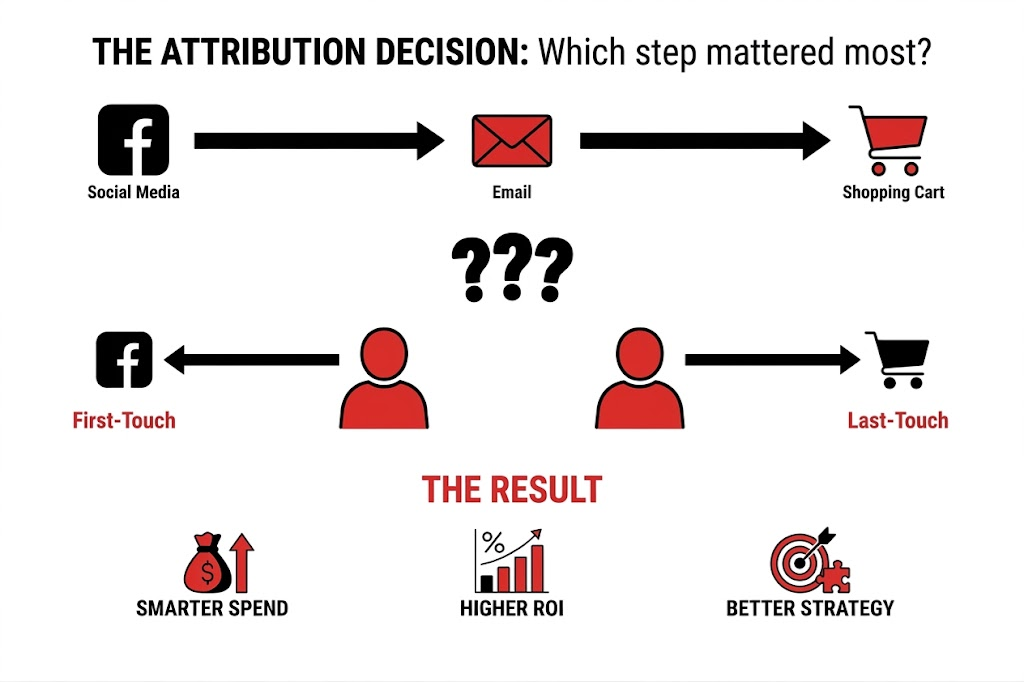
There is a reasonably good chance that your marketing team is making budget decisions based on wrong information. Not because they are careless, not because the data is missing, but because the attribution model sitting beneath their reporting is systematically misleading them about what is actually driving revenue.
Last-click attribution, the default in most analytics platforms, gives 100 percent of the credit for every conversion to the last touchpoint before purchase. It sounds logical, but it is not. It ignores every channel that built awareness, nurtured consideration, and created the conditions that made the final click possible. Over time, it systematically underinvests in the channels that matter most and overinvests in the ones that merely close.
I built a multi-touch attribution model for a gaming and entertainment platform in the UAE, a business with a complex, multi-channel acquisition model and a genuine need to understand which parts of their marketing investment were creating value versus which were just showing up at the end of a journey someone else started. Here is what we found, how we built it, and what it changed.
Last-click attribution does not tell you what drove the conversion. It tells you who was standing at the door when the customer finally walked in.
The Last-Click Problem: A Concrete Example
Before getting into models and methodology, it is worth making the last-click problem concrete. Here is a typical customer journey that last-click attribution gets completely wrong:
| Last-Click Attribution: What It Tells You Paid Search drove this conversion. | vs | What Actually Happened Day 1: Brand search (organic) Day 3: Retargeting ad (display) Day 7: Email newsletter click Day 9: Social media engagement Day 11: Paid Search → Purchase |
| Result: 100% of budget credit goes to Paid Search. The email, the display ad, and the organic search that started the journey receive nothing. Budget decisions follow. | Position-based model: 20% to organic search (first touch), 5% each to display, email, social, 40% to paid search (last touch). Every channel gets credit for its role. |
This is not a contrived example. It is the structure of most modern customer journeys, especially in competitive consumer categories where purchase decisions take days or weeks and involve multiple channels. When you report on this journey using last-click, you conclude that Paid Search is your best channel. You increase its budget. You reduce the email newsletter spend that started the relationship. Engagement drops. Conversions eventually follow. You wonder why.
The Five Attribution Models: What They Are And What They Miss
Attribution is not a binary choice between last-click and something better. There is a spectrum of models, each making different assumptions about how customer journeys work. When scoping this project, we evaluated all five before making a final recommendation.

▲ The five attribution models side by side
The key insight from evaluating all five is that no model is objectively correct: they are all approximations of a messy reality. The question is not which model is true, but which model is most useful for the decisions you need to make. First-Touch is useful if your primary question is 'what introduced customers to us?' Last-Touch is useful if you are focused purely on what closes deals. For a business trying to optimise a multi-channel acquisition model with a mix of brand and performance channels, both extremes are misleading.
Why We Chose Position-Based Attribution
Position-based attribution made sense here because both ends of the customer journey were genuinely earning their credit. The product carried enough unfamiliarity in the market that first-touch had real work to do, not just generating awareness but explaining the mechanics, building credibility, and turning a novel concept into something a consumer would seriously consider.
At the same time, this is a Dubai brand operating in one of the world's most aspirational markets: the final touchpoint before conversion needed to land emotionally, not just logically, and in a category where desire and aspiration drive decisions as much as rational evaluation, the last interaction was often the one that made the case the middle of the funnel couldn't.
The position-based model gives 40 percent of credit to the first touchpoint (the moment of acquisition) and 40 percent to the last touchpoint (the moment of conversion). The remaining 20 percent is distributed equally across all middle touchpoints.
What made this model particularly appropriate here was the nature of the business. With a mix of brand-building channels (organic search, social) and performance channels (email, paid search, display), a model that only credited conversion events would systematically starve the brand channels that were generating the demand those performance channels were harvesting. Position-based corrects for that while remaining interpretable enough that the marketing team can act on the outputs, something a fully data-driven model, requiring significantly more volume and infrastructure, would not have delivered at this stage.

▲ How position-based attribution distributes credit across the customer journey.
How We Built It: The Methodology
Step 1: Data Collection And Integration
We gathered data from four sources: website analytics, CRM records, advertising platform exports, and sales transaction records. Each source tracks a different part of the customer journey, and joining them into a single unified dataset (one row per customer journey, with every touchpoint recorded in sequence) is where most of the project's technical effort was concentrated.
Everything was loaded into Google BigQuery for processing, with Looker Studio used for the final reporting layer. The choice to centralise in BigQuery was deliberate; it gave us the ability to run complex multi-touchpoint queries that would have been impossible in a standard analytics platform, and it kept the model portable and auditable.
Step 2: Evaluating And Selecting The Model
We ran all five models against the same dataset before making a recommendation. This was not just due diligence; it was genuinely informative. Seeing how dramatically different the channel credit distributions looked under different models made the case for model selection being a strategic decision, not a technical default. The difference between Last-Click and Position-Based attribution on this particular dataset was significant enough to justify an entirely different media plan.
Step 3: Metric Definition
With the model selected, we defined three metrics that would drive the analysis: Conversion Rate by Channel (what percentage of journeys that touched a given channel went on to convert?), Attribution Weight per Touchpoint (what credit share does each channel receive across all converting journeys?), and Predicted Customer Lifetime Value per attributed channel (which channels are bringing in customers who spend more over time, not just customers who convert first?).
The CLV dimension was the most important addition. ROI calculated only on initial conversion undervalues channels that bring in high-lifetime-value customers. A channel that brings in fewer customers who spend three times more over two years is worth more than a channel that brings in more customers who churn after one purchase. The attribution model needed to surface that distinction.
What The Model Revealed
When we presented the attribution model output, the finding that shifted the conversation most was the gap between budget allocation and attributed credit and how sharply these diverged across channels. Two channels were being significantly underinvested relative to what the model showed they were contributing. Two others were receiving more than the evidence justified. Reallocating budget without this analysis would have meant continuing to reward the channels that were harvesting conversions while starving the ones that were creating the conditions for conversion in the first place.
Paid Search Was The Most Capital-efficient Channel In The Mix
Paid search had been managed with a relatively modest budget, treated as a supplementary channel with a limited ceiling. The attribution model returned it as the second-largest contributor to conversion credit at 25 percent, a result that, mapped against actual spend, made it the highest-returning channel in the plan by a significant margin. It was being systematically underinvested, not because it had been overlooked, but because last-click attribution had been distributing its credit to display and email at the point of conversion, making paid search's upstream contribution invisible. The case for scaling it had never been made with the right evidence.
Email Marketing Was The Most Undervalued Channel
Under the legacy reporting model, email marketing was receiving budget proportional to its last-click conversion rate, which understated its role significantly. Position-based attribution revealed it as the single largest contributor to conversion credit in the entire mix at 30 percent, and as a consistent first-touch driver of high-value customer journeys. The CLV analysis reinforced this: email was bringing in customers who spent more over time than those acquired through paid search. A channel routinely treated as an operational function (newsletters, CRM sends, automated sequences) had come out as the most commercially important in the mix. The recommendation to reallocate budget from Display Ads to Email Marketing followed directly from this finding.
Social Media Was Doing Real Work: Just Not At The Right Price
Under last-click attribution, social media appeared to be a modest performer: low conversion rate, unclear ROI. Under position-based attribution, a more complete picture emerged. Social media was appearing consistently as a mid-journey touchpoint in high-converting customer journeys. Customers who engaged with social content in the middle of their journey were more likely to convert and more likely to become high-CLV customers. The channel was not closing deals. It was qualifying prospects that performance channels then converted, a role last-click had made entirely invisible.
But the model also exposed the other side of that finding. Social had received the largest budget allocation in the plan while returning 15 percent of attributed conversion credit. It was not failing; it was expensive relative to what it was delivering. The team had been measuring social on engagement metrics and pricing it accordingly. Position-based attribution reframed it as a mid-funnel assist channel, genuinely valuable in that role, but not worth what it had been costing when measured against commercial outcomes.
Display Ads Were Harvesting, Not Creating
Display retargeting was showing strong last-click numbers, appearing to close a significant proportion of conversions. The position-based model told a different story. Display was almost exclusively appearing as a late mid-journey or last touchpoint on journeys that had been initiated by other channels. It was retargeting customers already in the funnel rather than bringing new customers in. A valuable role, but not one that justifies a meaningful share of the media budget when Email, Paid Search, and Organic Search are the channels doing the heavy lifting upstream, and when the budget released from display can be redirected to the channels that are genuinely creating the demand it was claiming credit for.
The Budget Reallocation: Before And After
The attribution analysis directly informed a reallocation of the media budget. This is the point where attribution modelling either earns its place or becomes an expensive academic exercise, when the findings change what the business actually does with its money.

▲ Budget allocation before and after attribution modelling.
The before state is a reasonable approximation of what last-click attribution produces when budget decisions track reported performance. Display Ads and Social Media receive outsized budget because they appear in conversion paths. Email Marketing is underweighted because its role is earlier in the journey and therefore invisible to last-click reporting.
The after state reflects what position-based attribution recommends when the full journey is visible. Email Marketing becomes the largest single channel by budget, not because it was previously ignored, but because the data showed it was doing more work than its budget reflected. Display Ads are reduced substantially, with budget redirected to channels that initiate journeys rather than close them.
The Results

▲ Impact and outcomes from the marketing attribution project. The 17% estimated ROI increase and 10% CLV uplift reflect the combined effect of better budget allocation and a clearer understanding of which channels drive long-term customer value.
The 17 percent estimated increase in ROI reflects the combined effect of redirecting budget from lower-attribution channels to higher-attribution ones. The 10 percent predicted CLV uplift comes from the channel mix shift itself: Email Marketing and Organic Search, which were elevated by the model, bring in customers with demonstrably higher lifetime value than Display retargeting.
Worth being transparent about what these numbers represent: estimated and predicted, not reported actuals. Attribution modelling projects future impact based on historical data and model assumptions. The actual ROI uplift depends on execution, market conditions, and factors outside the model's scope. The value of the exercise is not precision, but it is direction. And the direction here was clear.
The value of attribution modelling is not a precise number. It is the confidence to stop defending a budget allocation you cannot justify and start building one you can.
What This Means For Your Business
You do not need a complex build to start thinking differently about attribution. Three things to take from this post:
- Check your default model. If your analytics platform has never been explicitly configured for attribution, it is almost certainly running last-click. That is not a neutral choice, it is an active decision to ignore most of your marketing investment. Start there.
- Map a real customer journey before you model. The most valuable part of any attribution project is not the model output. It is the process of tracing actual customer journeys end to end and seeing where your assumptions about channel roles are wrong. That exercise alone will change how you read your existing reports.
- Include CLV in your attribution metrics from the start. Conversion-rate attribution optimises for volume. CLV attribution optimises for value. Those are different objectives and they produce different media plans. The business you want is the one that optimises for value.