
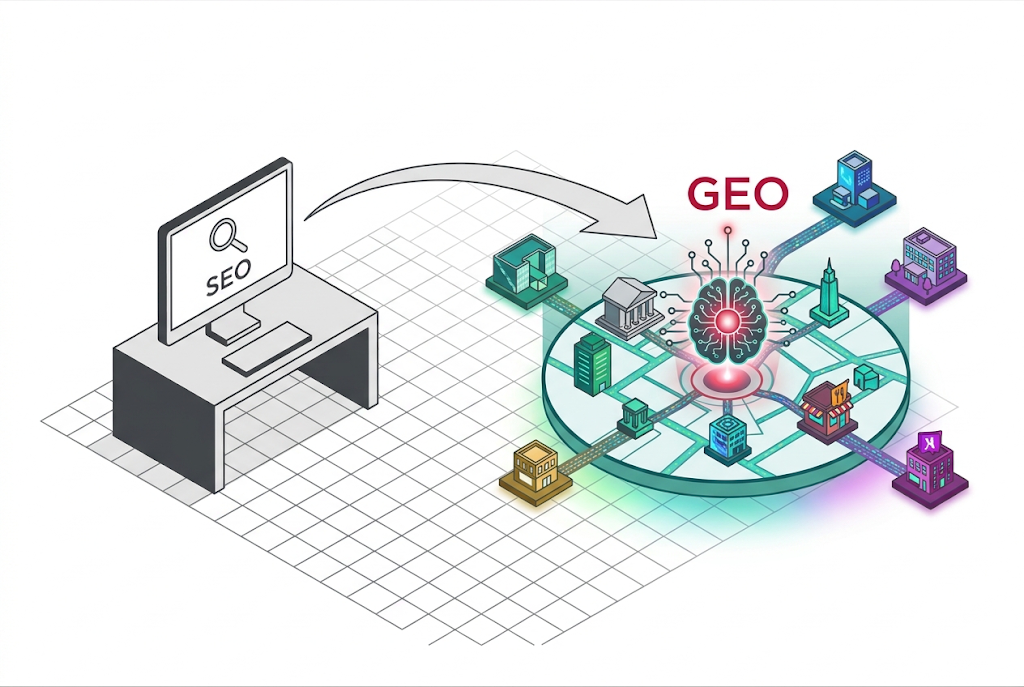
I have been working in SEO long enough to have lived through Google’s Panda update, the rise of mobile-first indexing, the death of exact-match domains, and more algorithm changes than anyone should be expected to keep track of. Each time, the same debate resurfaced: is SEO dead? Each time, the answer was the same: no, but the tactics that were working last year are no longer the ones that work now. The shift we are in the middle of is the most significant since Google introduced PageRank. The difference is that this time, the change is not algorithmic. It is architectural.
The way people find information is changing in a way that goes beyond a new ranking factor or a penalty for thin content. The search engine model of type a query, receive a list of links, visit several pages, synthesise the answer yourself is being replaced, for a growing category of queries, by a model where the AI does the synthesis and presents the answer directly. The links, in this new model, are optional. The click, in many cases, never happens.

The Shift That Google Could Not Ignore
The launch of ChatGPT made visible a user behaviour shift that had been building for some time. The value proposition of a large language model is not just that it knows things, but it is that it does the research for you. In the search engine era, a user asking a complex question still had to open five tabs, read three articles, and form their own synthesis. An LLM collapses that into a single response. The time saving is real, the convenience is real, and once users experienced it, the expectation changed.
Google saw the signal. Organic click-through rates on informational queries had been declining for years as featured snippets and knowledge panels provided answers without requiring a click. The launch of AI Overviews, the AI-generated answers now appearing above organic results on a growing proportion of Google searches, was not a bet on the future. It was a response to a present in which not responding would have cost Google significant ground to a generation of users who had started forming their research habits elsewhere. The data in Google Search Console tells the story clearly for businesses paying attention: queries where impressions are holding or growing but click-through rates are falling are almost invariably the ones where AI Overviews are being served. The traffic is not disappearing. The click is.

This pattern is visible in the GSC data of e-commerce and retail clients: impressions are holding, but click-through rates have dropped significantly as AI answers absorb the informational queries that used to drive traffic to product and category pages. The downstream effect on conversion metrics has been real: fewer clicks means fewer entry points into the purchase funnel, and most of these businesses are still in the early stages of understanding what the adapted strategy looks like.
The Principle That Survived The Shift
Here is what I have come to after years in SEO and a year watching the GEO conversation develop: the most important principle in search has not changed. It was always about creating content so good that other people reference it. Google’s original insight and the idea behind PageRank, was that a link from one site to another is a vote of confidence. The more links a page accumulates from credible sources, the more credible the page. Marketers abused this by building links inorganically, which is why Google spent fifteen years building systems to distinguish earned links from manufactured ones. But the underlying logic was always sound: if your content is genuinely the best answer to a question, people will reference it, link to it, and cite it without being asked.
Large language models learn in a fundamentally different way from search engines, but they arrive at something remarkably similar. They do not crawl and rank. They learn from the corpus of text they are trained on and that corpus reflects, more than anything else, what the internet has chosen to reference, quote, discuss, and link to over time. A brand or a piece of content that has accumulated genuine authority signals like backlinks from credible sources, citations in authoritative publications, consistent mention across reputable platforms, is far more likely to be represented accurately and confidently in an LLM than one that has not. The mechanism is different. The outcome of doing the fundamentals well is the same.
GEO does not replace what good SEO was always trying to do. It rewards it more completely. The shortcuts that worked around quality like inorganic links, thin content, exact-match keyword stuffing etc. have even less value in an LLM world than they did in the post-Panda search world.
The Reversal Of The Level Playing Field
One of the most significant things the early SEO era produced was a partial levelling of the competitive landscape. A well-optimised page from a small business could outrank a household brand for specific queries if the content was better and the technical execution was sound. This democratisation was real, and it produced a generation of digital-first businesses that competed effectively against incumbents by being smarter about search.
GEO has shifted that dynamic. Large, established brands hold a structural advantage in LLM representation that is harder to close than it was in traditional search. The reason is reputation capital: the accumulated weight of years of coverage in authoritative publications, backlinks from credible sources, Wikipedia entries, knowledge graph appearances, and consistent mention across trusted platforms. An LLM trained on the web’s historical content has absorbed all of that. A new brand or a smaller player starting from scratch does not have years of reputation signals to draw on, and building them takes time in a way that cannot easily be accelerated. The gap between established and emerging brands in LLM representation is currently wider than the equivalent gap was in organic search.
This does not mean smaller brands cannot compete. It means the strategy is different. Rather than trying to outrank established players on high-volume generic queries, the GEO opportunity for emerging brands is in the specific, the niche, and the deeply expert areas where they can be the most authoritative voice and build genuine representation in the areas where they most need to be found.

How LLMs Learn What You Are
Understanding GEO requires understanding how LLMs represent knowledge, which is meaningfully different from how search engines index it. A search engine crawls a page and evaluates it against hundreds of ranking signals including content quality, page speed, backlinks, structured data, user engagement. The output is a ranked list of pages. An LLM is trained on text at scale and learns associations, patterns, and entities from that text. The output is a model of the world that can generate answers based on what it has learned.
For a brand, this means the question is not ‘does Google rank my page?’ but ‘does the model know what I am, what I do, and when to mention me?’ Entity clarity is the foundational concept here. An entity is a clearly defined, consistently described thing like a business, a person, a product, a concept, that the model can recognise and accurately characterise. Brands with strong entity clarity have consistent descriptions across Wikipedia, knowledge graphs, authoritative publications, and their own well-structured content. Brands with weak entity clarity are described differently in different places, have thin or absent entries in structured knowledge sources, and are consequently represented inconsistently or inaccurately in model responses.
There is also the question of retrieval. Some AI systems, Perplexity being the clearest example, supplement their training with real-time web retrieval, citing specific sources in their answers. For these systems, the ability to appear in citations is more directly analogous to search ranking. For systems that rely primarily on trained knowledge, the path to representation runs through the training data itself, which means the quality, authority, and reach of content published before the model’s training cutoff.
GEO Strategy In Practice
The strategic implications are more concrete than the GEO discourse often suggests. Entity establishment is the starting point: ensuring that your brand, its products, and its key people are accurately and consistently described across the sources that LLMs most weight. This means Wikipedia where warranted, Wikidata entries, Google Knowledge Panel accuracy, schema.org structured data on your own properties, and consistent NAP (name, address, phone) data across directories. None of this is new; it was good practice in SEO. In GEO it is foundational rather than supplementary.
Content architecture matters more than individual page optimisation. LLMs favour comprehensive, well-structured content that addresses a topic thoroughly over page-by-page keyword targeting. The question to answer in a GEO content strategy is not ‘what keyword does this page target?’ but ‘what is the canonical answer to this question in our domain, and does our content contain it?’ Answer-first structure, clear headings, cited facts, and original data or analysis are the characteristics of content that gets ingested, cited, and surfaced.
Being cited by authoritative sources remains the highest-value signal. A mention in a well-regarded industry publication, a citation in a research report, coverage in Bloomberg or Reuters, these carry more GEO weight than ten blog posts on your own domain because they signal to the model that external, credible voices consider you worth referencing. The inorganic link-building tactics that search marketers eventually learned to avoid are even less effective in GEO. The path is earned coverage, not manufactured citations.
Measuring What Matters Now
This is where the discipline is least developed and, for practitioners with SEO backgrounds, most disorienting. The measurement infrastructure built over two decades for search like keyword rankings, organic traffic by query, click-through rate, position in SERP etc. does not translate directly to the GEO environment. AI responses do not have positions. Traffic from an AI answer that was never clicked does not appear in analytics. A brand mentioned prominently in an LLM response for a high-value query may be generating significant consideration without a single attributable session.
The practical approach in 2026 combines two data sources. The first is Google Search Console, used differently from how it has typically been used. The signature of AI Overview cannibalization is visible in the data: queries where impressions are stable or growing but click-through rates are declining. These are the queries where Google is serving AI-generated answers above organic results, absorbing informational intent without producing a click. Identifying these queries in GSC tells you precisely where your organic traffic is being displaced by AI and therefore where your GEO efforts need to focus. The second data source is AI-specific visibility tooling: platforms like Scrunch, Semrush’s AI toolkit, and Ahrefs’ emerging AI features track whether and how your brand appears in AI responses for specific query categories. Used together, GSC identifies the queries where AI is taking traffic, and AI visibility tools show whether your brand is present in those AI answers.
The vendor landscape has responded to this need with speed. Adobe LLMO, Scrunch, and a range of niche players have built monitoring and optimisation tooling specifically for LLM visibility. The established SEO platforms like Ahrefs and Semrush in particular, have integrated AI Overview tracking and brand mention monitoring into their core products. Volume-focused content tools like AutoSEO have emerged for brands pursuing scale in LLM-optimised content generation. Clients are increasingly aware of the shift, the questions about GEO strategy are coming proactively rather than reactively, which is a positive signal that the discipline is maturing.

The GCC Dimension
The GCC market has a specific version of the GEO challenge that is worth addressing directly. Frontier LLMs are trained predominantly on English-language web content and Arabic represents roughly 3% of web training data despite Arabic being the fifth most spoken language globally. The consequence is that the quality and accuracy of LLM representation degrades materially for brands and entities that exist primarily in Arabic-language web environments. A GCC brand with consistent coverage in Bloomberg, Reuters, The National, or Arab News in English will be significantly better represented in frontier AI models than one whose digital presence is primarily in Arabic.

The large, internationally reported GCC brands like Emaar, ADNOC, e&, Careem, Noon etc. have reasonable LLM representation because years of English-language business and financial media coverage have established their entities in the training data. Mid-market and emerging GCC brands, particularly those with primarily regional Arabic-language presence, are substantially underrepresented. This creates both a risk and an opportunity. The risk is that GCC brands are described inaccurately or not at all in the AI answers that their prospective customers are increasingly relying on. The opportunity is that the field is less crowded than in Western markets, and the investment required to establish strong GEO presence for a GCC brand in 2026 is considerably lower than it will be in three years.
The practical starting point for GCC brands is establishing accurate, comprehensive entity presence in English-language authoritative sources: Wikipedia entries where the brand merits them, English-language press releases distributed through international wire services, and structured data on English-language brand properties. This is not a suggestion to deprioritise Arabic-language SEO; it remains critical for reaching Arabic-speaking audiences through traditional search. It is a recognition that LLM representation currently requires English-language authority signals in a way that may evolve but has not yet resolved.
SEO And GEO Are Not Alternatives
The framing of GEO as a replacement for SEO is premature and misleading. Google’s organic search results still drive significant traffic, and will continue to do so. The queries most affected by AI Overviews are informational: how, what, why questions where an AI summary satisfies the intent. Commercial and transactional queries like where to buy, which service to hire, and local business searches still resolve predominantly through organic results and paid search. The portfolio of work required is an expansion, not a pivot: the same investment in content quality, entity clarity, and earned authority that makes a brand strong in GEO also makes it strong in SEO.
What changes is where you focus attention and how you measure success. The SEO toolkit is not obsolete. The metrics used to justify it need expanding. Organic traffic remains a meaningful signal, but the absence of a click no longer means the absence of discovery. A brand that appears confidently and accurately in AI responses to high-value queries is reaching an audience in a way that will not show up in session data and the practitioners who find ways to measure and optimise for that reach will have a genuine advantage over those still looking only at keyword rankings and click-through rates.
In the client conversations I am having, GEO is not replacing SEO; it is being understood as its logical progression into an AI-mediated world. The discipline is the same; the environment it operates in has changed, and the practitioners who adapt earliest will have the clearest advantage.