
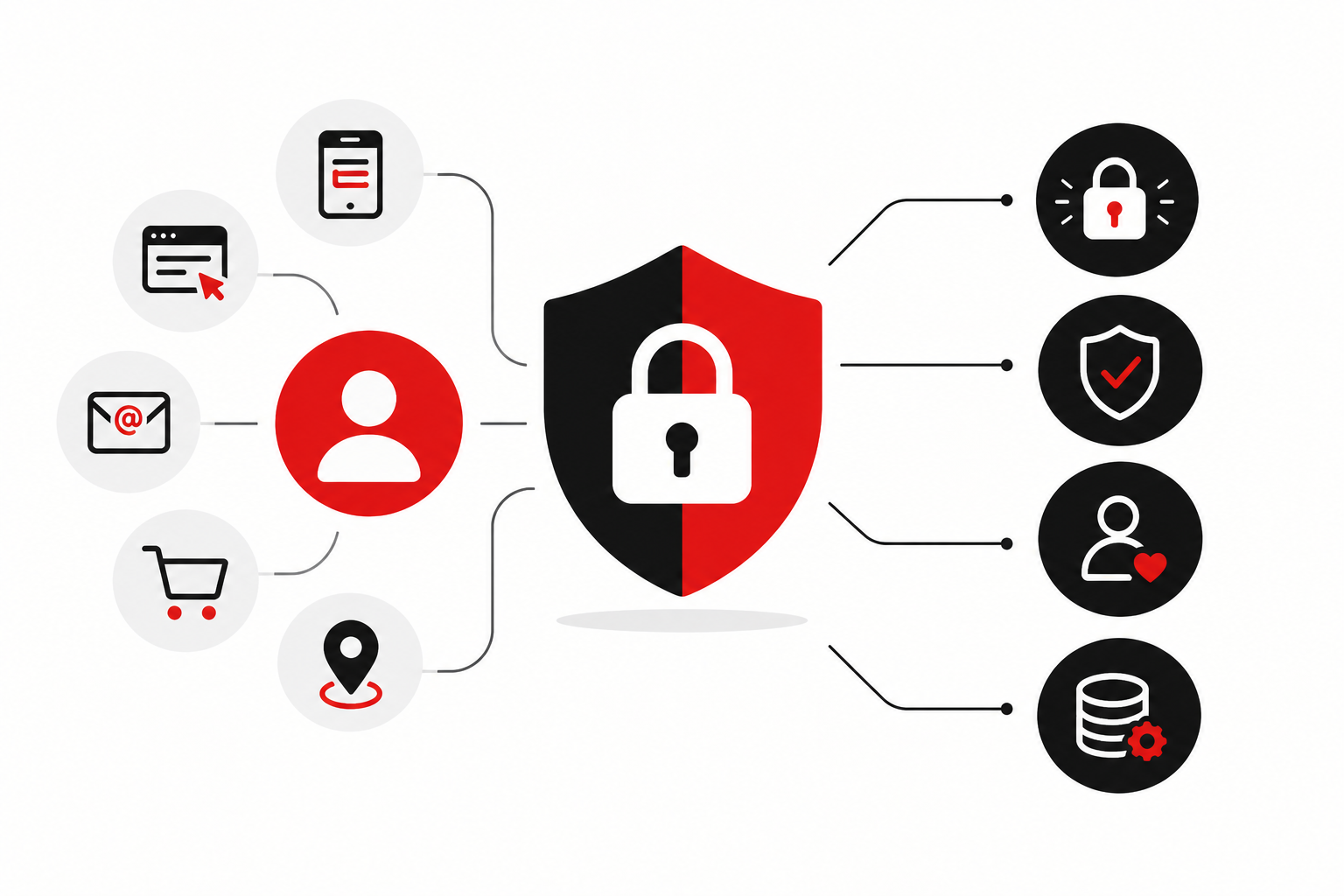
A retail operations manager runs a reactivation campaign for lapsed customers. The CRM pulls twelve thousand names. The campaign goes out via email and WhatsApp. Three thousand of the contacts transacted in-store last week, but that data was never linked to the digital profile. Eight hundred have opted out on WhatsApp, but the suppression was never synced. The campaign produces a reasonable open rate and some reported conversions. It also irritates the most engaged customers, contacts people who asked not to be contacted, and claims credit for transactions that would have happened anyway. Nothing in the reporting flags any of this. The data was all there. None of it was connected.
Most GCC organisations already collect a great deal of customer data. The problem is almost never volume. The problem is that they have lots of customer data and very little connected customer intelligence.
The distinction matters. Data collected in silos (a CRM here, a WhatsApp conversation there, an e-commerce transaction somewhere else, a loyalty programme running in parallel) is not the same as intelligence that can be acted on. The customer who visited the branch this morning, messaged on WhatsApp last week, and transacted on the app last month may exist in three separate systems with three separate identifiers, no linkage between them, and no consent history that can be demonstrated for any of it.
Building a first-party data strategy in the GCC means solving that connection problem and doing it in an environment where the regulatory landscape has shifted quite a lot, third-party data dependencies are being actively eroded by platform changes, and WhatsApp sits at the centre of customer engagement in a way that no global playbook was designed for.
The Real Gap: Not What You Collect, But What You Connect
When mapping where GCC organisations actually stand on first-party data, collection is rarely the issue. Behavioural events, transaction history, contact details etc., all of this is being generated. The gaps are consistently in three areas: cross-channel identity resolution, consent history, and offline-to-online data linkage.

WhatsApp, in-store interactions, and call centre data are almost universally collected in some form. They are almost never connected to the same customer record that CRM and e-commerce use. A customer who opts out on WhatsApp may still receive campaigns through email because the suppression was never synced. A high-value in-store customer may receive irrelevant digital advertising because the offline-to-online linkage was never built.
The lifecycle signals that would power retention and churn models like engagement drop-off, service escalation, channel migration etc. are distributed across systems that have never been reconciled.
The pattern is consistent across organisations that have done this work: retention performance improves not because the volume of data increases, but because the data becomes usable. A customer profile that combines purchase history, service interactions, and channel engagement can support a meaningful retention intervention: a timely offer, a relevant message, a reason to return.
A collection of disconnected records from those same channels cannot do any of those things, regardless of how much data sits in each individual system. The gap between collecting customer data and connecting it is not a technical gap. It is the difference between having evidence and being able to act on it.
The first-party data gap in the GCC: It is not a collection problem. It is a connection problem, and the gap between what is collected and what is activated is where most of the commercial value is being left on the table.
The Regulatory Landscape: More Complex Than Most Organisations Realise
The GCC's data privacy regulatory environment has changed significantly in the recent years. Bahrain led the region with a national data protection law in 2018, but the pace accelerated sharply from 2021 onwards. Organisations operating across the GCC now face multiple overlapping frameworks with different requirements, different enforcement bodies, and different territorial scopes.

Saudi Arabia's PDPL, implemented by the Saudi Data and Artificial Intelligence Authority (SDAIA), came into force in September 2023 with active enforcement. It applies to all personal data processed in relation to Saudi residents, including by non-Saudi entities, and requires explicit consent for most processing, with stricter requirements for sensitive data categories. Data localisation requirements apply in regulated sectors including government and banking.
The UAE has three distinct frameworks operating simultaneously. The Federal Personal Data Protection Law (Decree-Law No. 45 of 2021) applies across mainland UAE and came into full enforcement in 2024. Within the DIFC, the Data Protection Law (No. 5 of 2020, updated 2024) applies a GDPR-aligned framework that is the most comprehensive in the region and includes mandatory breach notification and Data Protection Officer requirements. ADGM has its own 2021 Regulations, also GDPR-aligned, for entities registered in that jurisdiction. An organisation with operations spanning mainland UAE, DIFC, and Saudi Arabia is subject to all three frameworks simultaneously.
Oman enacted its Personal Data Protection Law in 2022. Qatar and Kuwait have sectoral frameworks with broader national legislation in development. The direction of travel across all GCC jurisdictions is consistent: stronger consent requirements, clearer data subject rights, and increasing enforcement activity.
The compliance reality: awareness is high; operational execution is lagging. Most organisations have legal reviews, policy documentation, and governance frameworks in place. The harder work of embedding privacy into identity systems, activation workflows, consent tracking, and cross-channel orchestration is still in progress for many. Compliance maturity consistently lags transformation ambition. The hardest part is not the policy documentation as most organisations have that. It is the retroactive consent audit: establishing a clean, demonstrable consent record for channels like WhatsApp where informal opt-ins have accumulated over years, and where the history cannot be reconstructed from systems that currently exist. This is the compliance gap that creates the most immediate legal exposure, because it is a gap in a channel that is already in active, high-volume use.
The WhatsApp Problem: Consent On A Channel Not Built For It
WhatsApp penetration in the GCC exceeds 90% of smartphone users, which is among the highest in the world. For most regional businesses, it is not an optional engagement channel. It is core customer infrastructure: the primary channel for service, sales, relationship management, and often loyalty. This creates a consent challenge that has no equivalent in Western markets, where email compliance frameworks were established long before the channels themselves matured.
The challenge is that most GCC organisations adopted WhatsApp operationally before they built formal consent governance. The channel grew faster than the compliance architecture. So the common state is: opt-ins captured informally through verbal agreement, in-store staff-led enrollments, or assumed consent; no timestamp or channel record of when or how consent was obtained; CRM not synced with WhatsApp status; suppression lists maintained manually and applied inconsistently; and no audit trail that would satisfy a regulatory review.

Under both Saudi PDPL and UAE Federal PDPL, consent must be explicit, informed, and demonstrable. The informal opt-in processes that many organisations currently rely on for WhatsApp are unlikely to satisfy this standard if challenged. The DIFC framework goes further, requiring records to be maintained of consent given and withdrawn, and for withdrawal to be honoured promptly across all processing activities.
The more mature organisations are now moving toward centralised consent layers: a unified customer profile that stores timestamped opt-in records by channel, with real-time sync to CRM and activation systems, and automatic suppression propagation when consent is withdrawn. This is not primarily a compliance project, but it is an infrastructure project with compliance as the minimum acceptable output. The commercial value of a clean, auditable consent record is that it enables activation at scale with confidence, rather than campaign-by-campaign risk management.
The strategic reframe: WhatsApp consent architecture is not a legal checkbox. It is the infrastructure that allows you to use your most commercially important channel at scale, with confidence, as regulatory scrutiny intensifies.
Third-Party Dependency: The Platform Crutch That Is Being Removed
Many GCC organisations remain heavily dependent on Meta targeting, Google ecosystem data, marketplace platform intelligence, and platform-owned attribution models. Compared to more mature markets, there is often weaker first-party identity maturity, less experimentation culture, and lower CRM activation depth, meaning that when platform data quality degrades, the organisation has limited owned intelligence to fall back on.
The platform data environment has been deteriorating since Apple's App Tracking Transparency changes in 2021, and the deprecation of third-party cookie tracking across browsers has accelerated the pressure on platform-owned attribution. Meta's own research acknowledges a 15-20% underreporting gap in campaign measurement post-ATT changes. For GCC organisations that have been relying heavily on platform measurement to justify media investment, this creates a specific problem: the data that justified the spend is now less reliable, and the owned intelligence to replace it has not been built. The failure scenario is recognisable: a business running significant Meta spend finds that platform-reported ROAS has declined since ATT changes. The team cannot determine whether performance has genuinely dropped or whether the measurement has degraded. They have no owned attribution model to cross-check against, no CRM-based customer journey data to validate platform claims, and no suppression logic built on actual purchase history. The decision about whether to increase, maintain, or reduce spend is made on the basis of platform reporting that everyone suspects is incomplete, with no alternative data source to resolve the uncertainty.

The organisations pulling ahead are investing in three areas that compound: loyalty programmes that create authenticated customer journeys with known identities; CRM activation depth that moves beyond basic email to multi-channel orchestration including WhatsApp; and unified engagement history that enables the organisation to understand the customer relationship without relying on platform-reconstructed attribution.
The pattern across organisations that have invested in building owned data assets is consistent: return on marketing spend improves not because they reduce platform investment, but because they use it more precisely. Owned customer intelligence enables targeting based on actual purchase behaviour rather than inferred interest, suppression of customers who have recently converted or opted out, and attribution that does not depend entirely on what platforms choose to report back. Each of those three capabilities, better targeting, cleaner suppression, and independent attribution, compounds on the others. The organisations that lack them are not necessarily spending more; they are getting less from what they spend, and they cannot easily tell by how much.
What The Transition Looks Like In Practice
The success pattern is consistent across the businesses that have made meaningful progress on first-party data in the region.
A retail or service business connects CRM, e-commerce, in-store, and WhatsApp engagement data into a single customer view, not perfectly, but sufficiently. The linkage happens through phone number as a primary identifier, supplemented by email and loyalty ID. Once the unified record exists, three things change:
- Retention visibility improves: the organisation can see which customers are disengaging across channels rather than inferring it from a single channel signal
- Segmentation becomes meaningful: high-value customers can be identified by their total relationship with the brand, not just their last transaction in one system
- Campaign relevance increases: because the model knows the customer's full engagement history, it can suppress irrelevant messages and personalise the relevant ones
The failed version of this journey is where organisations invest in AI and personalisation before the identity and consent foundations are in place. The personalisation engine runs on a fragmented customer view and produces targeting that feels generic. Attribution remains unreliable because the customer cannot be tracked across channels. Organisational trust in the data erodes, investment cases for further work become harder to make, and the programme stalls.
The sequence matters as much as the investment. First-party data strategy is not a one-time project; it is an architecture that needs to be built in layers, with each layer enabling the next. Identity before personalisation. Consent before activation at scale. Owned intelligence before platform replacement.
The question is not whether first-party data strategy is worth doing. The timing argument is specific: platform data quality is actively deteriorating, consent requirements under Saudi PDPL and the UAE frameworks are already in force, and the informal WhatsApp consent practices that most organisations have relied on are no longer defensible under current law. These three pressures are converging simultaneously. The organisations that act now are building infrastructure that addresses all three at once. The ones that wait will be rebuilding under more pressure, with less time, and against competitors who have already built the capability they are still constructing.
Where To Start
In most GCC organisations, this work spans departments that do not naturally collaborate: customer data sits with marketing, operational data with service teams, in-store data with retail operations, and nobody currently owns the identity matching problem across all of them. The three priorities below are sequenced to create visible value quickly enough to build the cross-functional mandate that the broader programme requires. Three priorities that consistently unlock the most downstream value:
Make Phone Number A First-class Identifier
In the GCC, phone number is often the most reliable linkage key across channels; it is more consistent than email, more persistent than device IDs, more connected to real identity than cookies. This is particularly true in the region because phone number is tied to WhatsApp identity (the primary customer engagement channel), which means it is the single field that can bridge a customer’s digital engagement, service history, and transactional record into one view. No other identifier does this across offline and online touchpoints simultaneously. If your CRM, WhatsApp, loyalty programme, and e-commerce platform do not all use phone number as a primary field, the identity resolution project has a simple starting point: standardise the field and begin the matching exercise. This single step often reveals how much customer data is already present but unlinked.
Build A Consent Record, Not A Consent Policy
A privacy policy is not a consent record. A consent record is a timestamped entry in a customer profile that documents when, how, and for what the customer gave consent, and when they withdrew it. For WhatsApp specifically, this means auditing your current opt-in processes, identifying the gap between current records and what regulations require, and building the infrastructure to close it. This is a six-to-twelve week project for most organisations and not a multi-year programme.
Pick One Owned Data Asset And Make It Excellent
Loyalty programmes, authenticated app sessions, and CRM with genuine usage depth are the three most common high-value owned data assets in GCC retail and service businesses. Pick the one where you have the most existing data and the clearest commercial use case. Invest in making it excellent like having rich profile data, high match rates, meaningful activation. Use it to demonstrate what owned customer intelligence can do before expanding the investment.