
The build that started it all was deceptively simple: an AI note-taker. You speak, it transcribes, it saves. Useful, obvious, done in a weekend. But the moment I started building one, a different question took over: what happens after the note is taken?
A note on its own is just captured information. What knowledge workers, creators, and students actually need is not capture, it is transformation. Take the raw input and turn it into something they can use, publish, share, or act on. That shift in framing, from note-taker to content studio is what became Avenote.
The Idea: More Than A Note-Taker
Note-taking apps are a natural entry-level AI build: straightforward architecture, simple UI, quick to ship. The more interesting question is what comes after the note is taken.
The answer came from thinking about the people who would actually use it. An entrepreneur dictating a business idea needs more than a transcript; they need a structured brief, a social post, a pitch outline. A student recording a lecture needs a summary, a mind map, key action items. A content creator capturing a conversation needs an article draft, a newsletter, clips for different platforms. The note is the input. The output is where the value lives.
The idea was not to build a smarter note-taker. It was to build a machine that turns raw thought into finished content, automatically, in whatever format the user needs.
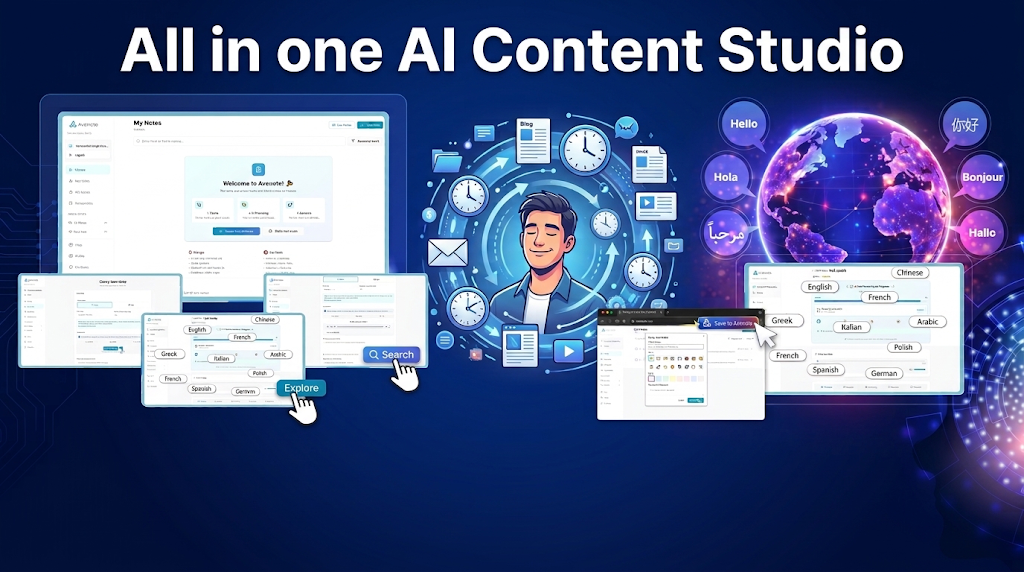
That vision became the design brief: an AI content studio that accepts any input (voice, text, documents, or web content) and transforms it into any professional output format. One capture. Unlimited use.

One platform handles the full journey: capture → transcribe → summarise → translate → generate. Zero tool-switching.
How It Grew: Five Layers, One Platform
Avenote was not designed up front as a fully featured platform. It grew feature by feature, each addition unlocking something that made the next one obvious. The result is five distinct capability layers built on top of each other.

Layer 1: Foundation, Getting Capture Right
Text notes came first. Simple, fast, reliable. Then audio recording because the most natural way to capture a thought is to speak it. These two input modes together established the foundation everything else would be built on.
Layer 2: AI Transformation, Doing Something Useful With It
Transcription via Whisper was the first AI layer. Once audio became text, translation and summarisation followed naturally. At this point the product was already useful: a voice memo that transcribes itself, produces a summary, and can output in multiple languages is genuinely time-saving. But it was still essentially a smarter note-taker.
Avenote accepts multiple capture methods: record directly in-app, upload an audio file by URL, or drop in a PDF or text document. The input method does not constrain what you can do with the content.
For audio: Whisper handles transcription across 33 languages with speaker-aware accuracy. For documents: parsing and chunking before transformation. The interface stays simple regardless of which path you take.
Layer 3: Content Generation, The Studio Becomes Real
The content generation layer is where Avenote became something different. Instead of one summary, users could choose from thirteen-plus output formats: article, blog post, mind map, story, outline, presentation structure, journal entry, newsletter, social post, and more. The same input, restructured for different purposes and platforms.
This is the layer that attracted the most varied users. A Product Manager using the mind map feature to visualise roadmap dependencies. A Senior CX Manager turning one voice brief into articles, emails, and social posts simultaneously. A Data Analytics Director generating content from call notes without starting from scratch each time. The format variety is what made Avenote multi-persona rather than single-use.
The format selector is where most users spend their time. Choose the output type, configure tone and length, and generate. The same input produces a polished article, a structured presentation, and a social post, simultaneously.
13 formats available: Article, Blog Post, Social Post, Email, Newsletter, Outline, Mind Map, To-Do List, Presentation, Story, Letter, Journal, FAQ.

Layer 4: Intelligence, Going Deeper
The interview feature added a new interaction mode: rather than generating content passively from input, users could interrogate it. Ask questions about the content, explore specific angles, extract particular insights. This turned Avenote into a research and synthesis tool, not just a generation one.
Organisation features came alongside: folder structures, tagging, and intelligent search. As users built up a library of notes and generated content, findability became a real need. The intelligence layer addressed both depth, what you can do with a single piece of content, and breadth, managing a growing body of work.
Layer 5: Integration, Connecting To Everything Else
The bookmarklet was the feature that surprised users most. Install it in any browser and you can capture content from any webpage: article, research paper, product page and immediately transform it into Avenote outputs. One Senior Voice Engineer described it as the feature that changed how he works: no more manual copying, no switching context, instant structured notes from whatever he is reading.
Zapier and Make integrations connected Avenote to the wider workflow ecosystem. Notes flowing into CRMs, summaries triggering email sends via SendGrid, content outputs feeding into publication workflows. Payments handled. The standalone content studio became part of a professional automation stack.

One Input. Thirteen Outputs.
The architecture of Avenote is designed around a single transformation engine that accepts multiple input types and routes them to whichever output format the user needs.

The engine is not doing one thing, it is orchestrating a sequence of AI operations depending on the input type and the requested output. A voice file goes through transcription before summarisation. A web capture goes through extraction before generation. A document upload goes through parsing before transformation. The user sees a simple interface. The platform handles the pipeline.
Who It Is Built For
The design target was anyone whose work involves converting ideas, conversations, or research into professional outputs. In practice, that covers more ground than anticipated.

While Avenote is a SaaS platform with no regional restriction, the multilingual layer carries particular relevance for professionals working across bilingual and multilingual environments. In the GCC context where knowledge workers routinely operate across Arabic and English, and frequently serve markets across multiple countries simultaneously, the ability to transcribe, translate, and generate content in 33 languages without switching platforms addresses a genuine operational friction. A voice note captured in Arabic can produce a structured brief in English, a social post in both, and a newsletter formatted for regional distribution. The workflow remains identical regardless of which language the original thought arrives in. That is not a regional feature; it is a core capability that becomes especially valuable in multilingual professional settings.
What Broke: The Regression Problem
Avenote grew fast, which meant the codebase grew fast. And fast growth in an iterative build environment creates a specific and frustrating problem: backward compatibility.
Each new feature touched existing logic. A change to how audio was processed affected transcription. An update to the content generation pipeline changed how summaries were formatted. A new output format required modifications to the transformation layer that rippled into existing formats. Fix one thing, break another.
This is regression, the enemy of iterative builds. It is not a sign that the architecture is wrong. It is a predictable consequence of building a platform that accumulates interdependent features over time without the testing infrastructure to catch interactions automatically.
The honest account: There was a period where stabilising the app took priority over adding features. Every session started with checking whether the previous session's fixes had broken something downstream. Gradual progress, but slower than expected and more humbling than the feature-building phases.
What eventually helped was a more disciplined approach to change isolation, that is making modifications in smaller, more targeted increments rather than larger feature additions, and testing core flows after every change rather than at the end of a build session. The platform stabilized and it also improved over that period, which helped. But the real fix was process, not technology.
Every ambitious iterative build hits this wall. The question is not whether it happens, but whether you keep building through it.
What Beta Users Said
Avenote went to a small group of beta users before any public launch, professionals across different roles, testing it against their actual work rather than contrived demos. The feedback was more positive than anticipated, and more specific than generic praise.
"Avenote has become a tool I genuinely rely on in my product workflow, from capturing ideas and structuring product thinking to automating presentations and sharing content across teams. The Mind Map feature has especially been useful for breaking down complex problems and visualising dependencies during roadmap planning. I would absolutely recommend it to product managers and anyone who regularly turns complex ideas into clear, shareable outputs."
"The Bookmarklet feature is incredibly intuitive, I can capture content from any webpage instantly and convert it into structured notes, which saves me so much time. The Interview module is such an innovative feature that helps me structure interviews, capture key insights, and turn conversations into actionable summaries. I've found it invaluable for research and professional assessments."
"Avenote takes your calls' notes to the next level. Not only can I get the transcripts, but I can also generate material out of them. I recommend it to anyone who constantly has regular strategic calls for work."
The three testimonials above represent distinct workflows: strategic planning and roadmap visualisation, research and synthesis from browsed content, and operational content generation from ongoing professional calls. The remaining beta participants across content creation, sales, and academic research independently converged on the same observation: the value is not in any single feature but in the elimination of context-switching between tools that normally surrounds content creation. A consistent thread across all feedback: users valued the multi-format output more than any individual capability. The ability to take one piece of captured content and produce an article, a social post, a presentation structure, and an email simultaneously, without rewriting, resonated across every role and use case tested. That was the core hypothesis. The beta confirmed it.
What It Does Not Yet Do
Video Input
One capability absent from the current version is video input. The consideration was practical: video files are substantially larger than audio, and building robust video ingestion would have added significant storage and processing requirements at this stage of the platform. There is also a meaningful copyright constraint, many of the most useful video sources for knowledge workers are YouTube videos, and programmatic transcription of YouTube content conflicts with the platform’s terms of service. Audio and document inputs cover the majority of real-world capture scenarios without either complication. Video remains a consideration for a future version.
Originality And AI-generated Content
A substantive concern raised during beta testing is the question of content originality. When output is generated directly from AI transformation, the content is technically derived from the user’s own input, but the generation process does not enforce originality against external sources. System prompt parameters provide some context and constraint, and users can configure tone and style, but those relying on Avenote for published content should apply their own editorial judgement on uniqueness and attribution. This is not a limitation unique to Avenote; it applies across AI content generation tools, but it warrants explicit acknowledgement. Strengthening the originality enforcement to the extent technically possible is an active area of product development.
Planned Capabilities And Current Constraints
Two capabilities that beta users identified as logical next steps are not yet in the platform. Voice cloning, the ability to have summaries and translated outputs rendered in the user’s own voice rather than a synthetic one, is on the planned enhancement roadmap. The technical groundwork for it exists; the implementation is a prioritisation decision rather than an architectural barrier. Collaborative editing and team-based access are also absent from the current version. Avenote today is a single-user studio. For agencies, content teams, and organisations that want shared workflows and simultaneous editing, this is a real constraint. Team features would change the platform’s positioning and addressable market significantly, and are among the most requested additions from the beta cohort.
Video Conferencing Integration
The absence of native integration with popular video conferencing tools like Zoom, Microsoft Teams, and Google Meet is arguably the most significant gap relative to the content studio positioning. The meeting room is where the highest-value unstructured professional content is created: strategy conversations, client briefs, retrospectives, research interviews. A content studio that can capture from a live meeting and immediately generate a summary, action items, an article draft, and a social post covers the full professional workflow. Without direct conferencing integration, users need to download their recording and upload it to Avenote, a workaround that works but introduces friction into what should be a seamless process. The ‘zero tool-switching’ principle the platform is built on applies most powerfully at the point where content is first created, and that point is increasingly the video call. Native integration with the popular tools is on the roadmap and would close the most material gap between the current version and the full content studio vision.
Language Coverage: Indian Regional Languages
The platform currently supports 33 languages through the Whisper transcription layer. However, a significant portion of the pilot cohort was based in India, and feedback highlighted that accuracy on Indian regional languages (Tamil, Malayalam, Kannada, Bengali, Marathi, and others) falls short of the standard required for professional content generation. This is partly a constraint of the underlying transcription model rather than a product design choice; Whisper’s accuracy on Indian regional languages is uneven at current model versions. For a content studio, the language layer is not a peripheral feature, it is central to the value proposition. The ability to capture a thought in your native language and output it in the format and language your professional context demands is precisely what distinguishes a content studio from a basic transcription tool. Expanding the language layer to cover Indian regional languages at the accuracy the content studio use case requires is a near-term product priority, informed directly by where the early user base is concentrated.
What The Build Taught Me
Start With The Transformation, Not The Capture
The note-taking part of Avenote is straightforward. The value is in what happens next. If I were starting again, I would define the output formats first; what does the user need to have at the end and work backwards to determine what inputs are needed to produce them. The capture layer is infrastructure. The generation layer is the product.
Feature Breadth Creates Unexpected Users
I built Avenote with a few target personas in mind. The beta users who got most value from it were not always who I expected. The bookmarklet became a defining feature for a user type I had not anticipated. The interview module resonated strongly with researchers and evaluators. Building broad with many output formats, multiple input types, created surface area for users to find their own high-value workflow. That is harder to design for than a focused single-use tool, but the payoff is wider adoption.
Regression Is A Tax On Speed
Moving fast in iterative builds accumulates technical debt in the form of untested interactions between features. The regression problems Avenote encountered were a direct consequence of prioritising feature velocity over stability. The tax comes due eventually and it costs more to pay it late than to build testing discipline in early.
Beta Feedback Is Product Strategy
The specific features users highlighted, the workflows they described, the suggestions they made all of that is more valuable than any product planning session. The Senior Voice Engineer's description of how he uses the bookmarklet revealed a use case I had not fully understood. The Product Manager's account of the mind map feature for roadmap planning showed a workflow that deserved more prominence. Beta users do not just validate, but they show you where the real value is.
What Avenote Is Now
Avenote is a fully featured AI content studio: five input types, thirteen-plus output formats, an interview and deep-dive mode, a complete organisation layer, and integrations with Zapier, Make, email, and payments. It went from a weekend build experiment to a platform with paying users and a beta cohort that provided some of the most encouraging product feedback I have received.
What Avenote demonstrates is the same principle as the AI Solution Advisor: the technology is not the hard part. Defining what transformation the user needs, building the output formats that actually serve their workflow, and maintaining stability as the platform grows, those are the hard parts. The AI is the engine. The product thinking is the design.
For anyone building in this space, the architecture pattern, one transformation engine, multiple input types, multiple output formats, is worth studying regardless of domain. Wherever the gap between raw capture and professional output is currently filled by human reformatting, there is an AI content workflow waiting to be designed. The platform is available at https://avenote.co