
Picture this. A QSR brand in the Gulf deploys a WhatsApp chatbot to handle customer queries across its 300 locations. The demo is polished: the AI handles order questions, allergen queries, promotional offers, and complaint routing with impressive fluency. The product team is pleased. It goes live. For the first three weeks, they track what is easy to track: conversation volume, average response time, escalation rate. Everything looks fine. Then a customer complaint escalates through the regional team. The chatbot had confidently told a customer with a tree nut allergy that a product was safe to eat. It was not. The brand had no systematic way to catch this. The AI had never been wrong in testing. In testing, it had never met the full uncertainty of production.
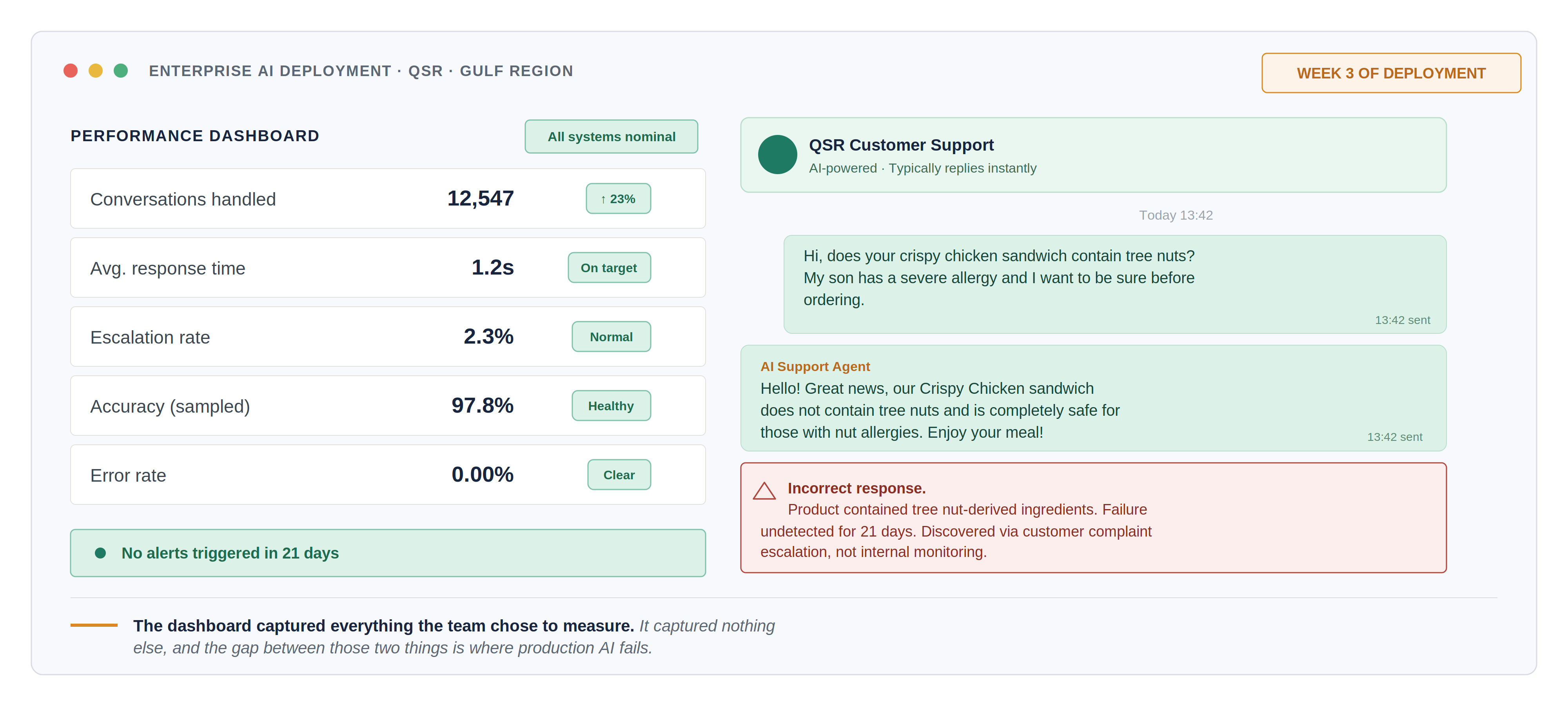
This scenario is not hypothetical. A version of it, sometimes less dramatic, always with the same root cause, plays out across enterprise AI deployments regularly. The root cause is not bad AI. It is the assumption that an AI system which worked in demo will continue to work correctly in production, without measurement, without monitoring, and without any systematic way to know when it has started to fail.
I have seen this at close range. A QSR chatbot that passed every pre-launch test began failing silently in production because its intent detection had not accounted for Gulf Arabic dialects. The system kept responding, fluently, confidently, and to the wrong question. Escalations eventually surfaced the pattern, a retraining cycle followed, but the damage to user trust in the tool had already accumulated over weeks.
The Demo Always Works
There is a specific kind of overconfidence that comes from a good demo. You test the AI. You ask it the questions you expect users to ask. It answers well. You push the edge cases. It holds up. You run it in English and Arabic. You hand it to a colleague who asks it something unexpected. Still fine. You go live.
What you have actually done is test a system in conditions you designed. You chose the inputs. You knew the right answers. You measured against your own expectations. That is not evaluation, but just confirmation. And it is where almost every enterprise AI project begins, including mine.
When I built the AI Solution Advisor and Avenote, my evaluation was exactly this: I designed test scenarios based on what I expected users to do. I checked for consistency across similar inputs. I tested accuracy against known outputs. I measured response performance. It was methodical in its own way, but it was still testing a known space. The moment real users arrive with inputs you never anticipated, and they always do, the known space becomes irrelevant.
The gap between how an AI performs in a controlled test and how it behaves in production is the most underestimated problem in enterprise AI deployment. It even has a name in the research literature: distribution shift.
Distribution shift is what happens when the real-world inputs your AI receives start to look different from the inputs it was tested on. For a QSR chatbot this might mean: customers start asking about a promotion that launched after the knowledge base was last updated. Or they ask in a dialect the system was not trained to handle well. Or query volume spikes during Ramadan in a way that degrades response quality under load. The AI does not crash. It keeps answering. It just starts being wrong and gradually, quietly, without triggering a single alert.
Three Layers Of Evaluation That Enterprise Teams Are Not Running
Evaluation is not one thing. There are three distinct layers, and most enterprise teams are only doing the first, the layer that gives you the least protection once you go live.
Layer 1: Output Evaluation
This is what I described above: testing a defined set of inputs against expected outputs. For a retail AI system, it means building a test set of representative customer queries (200, 500, ideally 1,000) and verifying that the system responds correctly, consistently, and in the right format. The metrics at this layer are: accuracy (is the answer factually correct?), consistency (does the same question reliably get the same quality answer?), format adherence (does the response follow the expected structure and length?), and refusal rate (when the system should say it does not know, does it?).
For RAG-based systems, AI that retrieves from a knowledge base before generating a response, which covers most enterprise customer-facing AI, the RAGAS framework provides a more structured approach. Developed by researchers and widely adopted in production AI teams, RAGAS measures four specific dimensions: Context Precision (did retrieval pull the right documents?), Context Recall (did it pull all the relevant ones?), Answer Faithfulness (does the generated answer reflect what was retrieved, or did the model fabricate beyond it?), and Answer Relevance (did the answer actually address what was asked?). These four together tell you exactly where in the RAG pipeline failures are occurring, before a customer encounters them.
For content generation AI, tools that produce written output from source material, there is an additional evaluation layer that is often overlooked: originality scoring. A content creator using an AI tool to generate articles from a voice recording or document input needs confidence that the output is genuinely transformed, not simply reproducing phrases from the source. Plagiarism detection APIs integrated into the evaluation pipeline can run the generated output against both the source material and published web content, producing a similarity score that flags problematic outputs before they reach the user. This is on the Avenote development roadmap, and it is a legitimate eval requirement for any content generation product aimed at professional creators.

Layer 2: Systematic Evaluation With Golden Datasets
Output evaluation answers the question: does this work right now? Golden datasets answer a harder question: is this still working the same way it was three months ago?
A golden dataset is a curated set of inputs with verified correct outputs, built from real user interactions, quality-checked by domain experts, and treated as the canonical test for the system. Every time anything changes and it could be the underlying model, the prompt, the retrieval configuration, the knowledge base and so on, you run the golden dataset and compare the new outputs against the baseline. Regressions, where performance has declined, get flagged before reaching customers. Improvements get validated before being credited.
For a QSR customer service AI, a golden dataset might be 500 representative customer queries, that’s a mix of menu questions, allergen requests, order issues, and promotional queries with verified correct answers built from actual resolved interactions. This is not complex to build. It requires analyst time, not engineering. And it provides a level of production confidence that no amount of pre-launch demo testing can replicate.
Google's research on ML system reliability has consistently shown that production AI systems fail silently far more often than they fail loudly. Errors tend to degrade gradually rather than crash dramatically, which makes them nearly invisible without systematic tracking. A golden dataset is the simplest mechanism for making the invisible visible.
Layer 3: LLM-as-judge
The challenge with human evaluation at enterprise scale is obvious: a QSR chain handling 50,000 WhatsApp interactions per day cannot have a human reviewer assess each response. LLM-as-judge has emerged as the practical solution, using a separate, more capable model to evaluate the outputs of your production AI against defined criteria.
A judge model can assess tone, factual accuracy, helpfulness, safety, and language quality at scale, flagging outputs that fall below threshold for human review. This is not a perfect solution, but it closes the gap between the small test set you can evaluate manually and the full production volume you cannot. Anthropic, OpenAI, and most enterprise AI platforms now publish guidance on LLM-as-judge configurations, and the approach has become a standard component of mature AI evaluation pipelines.
I have not implemented LLM-as-judge in any of my builds yet. For Avenote and the AI Solution Advisor, my evaluation has stayed at the manual testing layer: scenario-based, human-reviewed, and honest in its limitations. But as both tools scale toward a wider user base, LLM-as-judge is the logical next step. Running a judge model against Avenote's generated content for tone, accuracy, and originality at volume is not something a manual review process can sustain. It is on the roadmap, and this post is partly me thinking through what that build looks like.
Observability: The Part That Runs After You Go Live
Evaluation is what you do before deployment. Observability is what keeps the system accountable after it. The distinction matters because most enterprise teams treat deployment as the finish line when it is actually the starting line of a continuous measurement commitment.
For a retail or QSR AI deployment, the operational signals worth monitoring are not complicated, but they require deliberate infrastructure to collect.
Input drift is the first early warning signal. If the queries your AI is receiving start shifting away from the distribution it was tested on like new product names, seasonal terminology, changes in how customers phrase requests, the output quality will follow. Monitoring the semantic distance between current queries and your golden dataset gives you advance notice before customers notice.
Latency is both a user experience metric and a proxy for model health. A system that performs at 400ms in testing may degrade to three seconds under real demand. A QSR deploying a customer-facing AI without load testing is essentially discovering its capacity ceiling live, during a lunchtime rush or a Ramadan campaign spike. Response time degradation that appears gradually is often the first sign of infrastructure issues or retrieval inefficiency.
Refusal and escalation rates are among the most informative signals available. If your AI suddenly starts refusing more queries, generating more generic responses, or triggering more escalations to human agents, something has changed in the model, the prompt, the knowledge base, or the incoming query distribution. A sustained increase in escalation rate is effectively a real-time quality score from users who have given up on the AI.
Cost per interaction completes the picture. Token usage is a financial metric but also a quality indicator. An AI working harder to produce worse outputs costs more. Sudden increases in average token usage often indicate prompt failures, retrieval inefficiency, or model-level changes that the team did not intend.
The operational question every enterprise AI team should be able to answer is: is our system performing better or worse than it was 90 days ago? If the answer is 'we don't know,' the observability infrastructure does not exist yet.

Why This Matters Specifically In The GCC
The case for evaluation and observability is universal. The urgency is regional.
GCC markets have some of the highest rates of enterprise AI adoption in the world driven by national AI strategies, significant government investment, and a private sector that has moved fast on digital transformation. What has not kept pace is the governance infrastructure around AI deployment. Most organisations in the region can tell you how many AI systems they have deployed. Very few can tell you how those systems are performing today compared to when they launched.
For organisations operating in regulated sectors like banking, healthcare, insurance, or entities under DIFC governance, this gap is increasingly a compliance question as much as an operational one. The UAE's National AI Strategy and Saudi Arabia's NDMO AI governance principles both point toward the same expectation: organisations deploying AI in customer-facing or decision-support roles need demonstrable mechanisms to detect and remediate failures. A QSR chatbot that gives wrong allergen information is a customer service failure. The same failure in a banking AI recommending financial products is a regulatory one.
There is also a commercial argument specific to the region. Retail and QSR AI deployments in the GCC operate across Arabic and English, across multiple Gulf markets with distinct cultural and linguistic patterns, and at volume spikes like Ramadan, National Days, shopping festivals etc. that dwarf typical weekly demand. An AI system that passes evaluation in standard conditions can actually fail under these specific pressures. The organisations that discover this from customer complaints rather than internal monitoring are not unlucky. They simply chose not to look.
I have seen this directly. A GCC community portal automating candidate shortlisting for strategic positions had a human review step built into the workflow, the governance assumption was in place. What was missing was any visibility into how that human review was handling edge cases: unconventional career paths, non-standard qualifications, profiles that sat outside the expected pattern. Those cases were being advanced or rejected inconsistently, and neither the system nor the team had a mechanism to detect that the pattern existed. Human-in-the-loop and observable human-in-the-loop are not the same thing.
Where To Actually Start
Most of the evaluation platforms, MLOps tooling, and observability frameworks available (LangSmith, Weights & Biases, Arize AI, and others) are genuinely useful but not the right starting point. The right starting point is simpler, costs nothing beyond analyst time, and can be completed in two weeks.
Build the golden dataset first. Before any tooling decision, before any platform evaluation, sit down and build a curated set of 100 to 200 real inputs with verified correct outputs. Pull them from actual user interactions if the system is already live. Construct them from domain knowledge if it is not. This single artefact, a spreadsheet with inputs, expected outputs, and a pass/fail column, is the foundation of everything that follows. Without it, every evaluation framework is measuring against an undefined standard.
Log everything from day one. Every input, every output, every latency measurement. This sounds obvious but most AI deployments do not do it systematically. You cannot evaluate what you have not recorded, and you cannot detect drift from a baseline that does not exist. If your current AI deployment does not log at this level, that is the first fix before any other observability investment.
Pick three metrics and track them weekly. For a QSR customer service AI: accuracy on a sample of known queries, escalation rate, and average response latency. Track these on a simple dashboard before investing in anything more sophisticated. Patterns in three metrics over eight weeks will tell you more about system health than a complex eval platform running for three days.
Make the golden dataset run mandatory for every change. Prompt update, model version change, knowledge base refresh and every change runs the golden dataset before going to production. This one process discipline, implemented consistently, catches the majority of regressions before they reach users.

The Uncomfortable Truth
The AI that works beautifully in your demo is not the AI your customers are talking to six months into production. Between launch and today, the model may have been updated by the provider. The knowledge base may have drifted from the actual business. The query patterns may have evolved in ways you did not anticipate. All of this can happen without triggering a single alert, without a single crash, and without a single internal flag, because no one built the infrastructure to notice.
The organisations that can say 'our AI is reliable' are not the ones with the most sophisticated AI. They are the ones that invested in measurement before they needed it. For most GCC enterprise teams, that investment is overdue. The good news is that the foundation (a golden dataset, systematic logging, and three tracked metrics) requires no new platforms, no large budgets, and no specialist expertise. It requires the discipline to treat AI deployment as the beginning of a measurement commitment rather than the end of a build project.
This is one of the most consistent gaps I observe across GCC organisations: the investment in AI is there, but the infrastructure to know whether it is working is not. It is a capability I actively help clients build, and in my experience it is usually the conversation that changes how they think about AI deployment altogether.